---
title: How to Choose an Ocean Freight Forwarder in New Zealand (2026 Guide)
description: Choosing the right ocean freight partner for your New Zealand business? Here's what matters — FCL vs LCL, NZ ports, customs, and how to choose a forwarder.
image: https://info.oceania.kln.com/hubfs/Designer.png
---
[](https://oceania.kln.com)
- About us
- [Our Team](https://oceania.kln.com/about-us/team)
- [Oceania at a glance](https://oceania.kln.com/about-us/oceania-at-a-glance)
- [Sustainability](https://oceania.kln.com/about-us/sustainability)
- [Global network](https://oceania.kln.com/about-us/global-network)
- Content
- [KnowledgeHub](https://info.oceania.kln.com/knowledgehub)
- [Konnect](https://info.oceania.kln.com/konnect)
- [Customer Advisories](https://info.oceania.kln.com/customer-advisory)
- [Downloads & Resources](https://info.oceania.kln.com/downloads-resources1)
- Solutions
- [VBO - Supply Chain Command Center](https://info.oceania.kln.com/vbo)
- [KLN Online](https://info.oceania.kln.com/kln-online-solutions)
- Freight
- [Ocean Freight](https://info.oceania.kln.com/ocean-freight)
- [Air Freight](https://info.oceania.kln.com/air-freight)
- [Land Freight](https://oceania.kln.com/solutions/land-freight)
- [Multimodal](https://oceania.kln.com/solutions/multimodal)
- [Customs Brokerage](https://oceania.kln.com/solutions/customs-brokerage)
- [Cargo Insurance](https://info.oceania.kln.com/cargo-insurance)
- [Supply Chain Solutions](https://oceania.kln.com/solutions/supply-chain-solutions)
- [Consolidation](https://oceania.kln.com/solutions/consolidation)
- [Integrated Logistics](https://oceania.kln.com/solutions/integrated-logistics)
- Locations
- [Australia](https://oceania.kln.com/locations/australia)
- [Aotearoa New Zealand](https://oceania.kln.com/locations/aotearoa-new-zealand)
- [Global network](https://www.kln.com/en/network/)
- [Track & Trace](https://oceania.kln.com/track-trace)
- [Contact](https://info.oceania.kln.com/contact)
- [Subscribe](https://info.oceania.kln.com/subscribe-communications)
- About us
- [Our Team](https://oceania.kln.com/about-us/team)
- [Oceania at a glance](https://oceania.kln.com/about-us/oceania-at-a-glance)
- [Sustainability](https://oceania.kln.com/about-us/sustainability)
- [Global network](https://oceania.kln.com/about-us/global-network)
- Content
- [KnowledgeHub](https://info.oceania.kln.com/knowledgehub)
- [Konnect](https://info.oceania.kln.com/konnect)
- [Customer Advisories](https://info.oceania.kln.com/customer-advisory)
- [Downloads & Resources](https://info.oceania.kln.com/downloads-resources1)
- Solutions
- [VBO - Supply Chain Command Center](https://info.oceania.kln.com/vbo)
- [KLN Online](https://info.oceania.kln.com/kln-online-solutions)
- Freight
- [Ocean Freight](https://info.oceania.kln.com/ocean-freight)
- [Air Freight](https://info.oceania.kln.com/air-freight)
- [Land Freight](https://oceania.kln.com/solutions/land-freight)
- [Multimodal](https://oceania.kln.com/solutions/multimodal)
- [Customs Brokerage](https://oceania.kln.com/solutions/customs-brokerage)
- [Cargo Insurance](https://info.oceania.kln.com/cargo-insurance)
- [Supply Chain Solutions](https://oceania.kln.com/solutions/supply-chain-solutions)
- [Consolidation](https://oceania.kln.com/solutions/consolidation)
- [Integrated Logistics](https://oceania.kln.com/solutions/integrated-logistics)
- Locations
- [Australia](https://oceania.kln.com/locations/australia)
- [Aotearoa New Zealand](https://oceania.kln.com/locations/aotearoa-new-zealand)
- [Global network](https://www.kln.com/en/network/)
- [Track & Trace](https://oceania.kln.com/track-trace)
- [Contact](https://info.oceania.kln.com/contact)
- [Subscribe](https://info.oceania.kln.com/subscribe-communications)
- [Home](https://kerrylogisticsoceania.com/)
- [Articles](https://info.oceania.kln.com/knowledgehub)
- [Customs](https://info.oceania.kln.com/knowledgehub/tag/customs)
# How to Choose an Ocean Freight Forwarder in New Zealand (2026 Guide)
08 Jun 2026
[Customs](https://info.oceania.kln.com/knowledgehub/tag/customs) [Ocean Freight](https://info.oceania.kln.com/knowledgehub/tag/ocean-freight) [Freight Forwarding Tips](https://info.oceania.kln.com/knowledgehub/tag/freight-forwarding-tips) [Air Freight](https://info.oceania.kln.com/knowledgehub/tag/air-freight) [International Trade](https://info.oceania.kln.com/knowledgehub/tag/international-trade) [LCL](https://info.oceania.kln.com/knowledgehub/tag/lcl) [FCL](https://info.oceania.kln.com/knowledgehub/tag/fcl) [General Knowledge](https://info.oceania.kln.com/knowledgehub/tag/general-knowledge) [New Zealand](https://info.oceania.kln.com/knowledgehub/tag/new-zealand) [2026](https://info.oceania.kln.com/knowledgehub/tag/2026)
- [](http://www.facebook.com/sharer/sharer.php?u=https://info.oceania.kln.com/knowledgehub/how-to-choose-an-ocean-freight-forwarder-in-new-zealand-2026-guide)
- [](https://twitter.com/intent/tweet?url=https://info.oceania.kln.com/knowledgehub/how-to-choose-an-ocean-freight-forwarder-in-new-zealand-2026-guide&text=How%20to%20Choose%20an%20Ocean%20Freight%20Forwarder%20in%20New%20Zealand%20(2026%20Guide))
- [](http://www.linkedin.com/shareArticle?mini=true&url=https://info.oceania.kln.com/knowledgehub/how-to-choose-an-ocean-freight-forwarder-in-new-zealand-2026-guide)
- [](mailto:?body=https://info.oceania.kln.com/knowledgehub/how-to-choose-an-ocean-freight-forwarder-in-new-zealand-2026-guide)
- Copy to clipboardLink Copied
https://info.oceania.kln.com/knowledgehub/how-to-choose-an-ocean-freight-forwarder-in-new-zealand-2026-guide

☰ On this page
On this page
×
↑ Back to top
‹
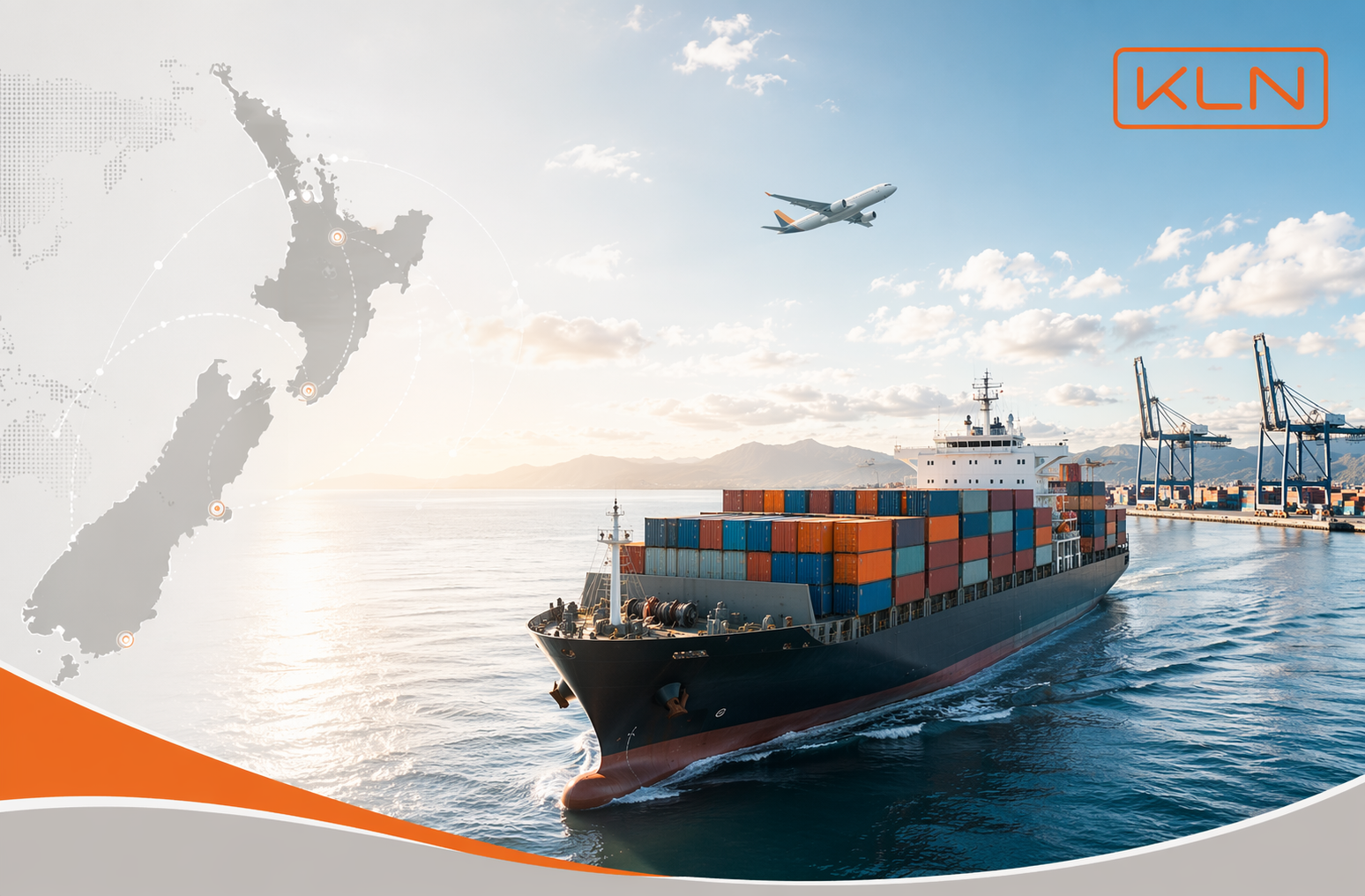
New Zealand's trading position is one of the most geographically isolated in the world. Every import or export shipment involves long ocean transit times, multiple carrier touchpoints, and strict biosecurity requirements at the border. In that environment, choosing the right ocean freight partner isn't a procurement checkbox: it directly affects your landed costs, your stock availability, and your compliance risk.
This guide breaks down what NZ importers and exporters actually need from an ocean freight service, and what to look for when choosing a provider.
## What Is Ocean Freight and How Does It Work for New Zealand Businesses?
Ocean freight is the movement of cargo by sea in standardised [shipping containers](https://info.oceania.kln.com/resources-shipping-container-guide) aboard commercial vessels. For most New Zealand businesses, it is the primary mode of international trade: significantly more cost-effective than air freight for the majority of cargo types.
Shipments enter and leave New Zealand through the country's main container ports (Auckland, Tauranga, Lyttelton, and Port Chalmers) , connecting to hub ports across Asia, Europe, and the Americas via scheduled liner services. Your freight forwarder manages the booking, documentation, [customs](https://info.oceania.kln.com/knowledgehub/customs-brokerage-essential-guide), and inland coordination so you don't have to deal directly with the shipping lines.
## What's the Difference Between FCL and LCL Shipping?
[FCL (Full Container Load)](https://info.oceania.kln.com/newzealand-solutions)means you book the entire container. [LCL (Less than Container Load)](https://info.oceania.kln.com/knowledgehub/ultimate-guide-lcl) means your cargo is consolidated with other shippers' goods in a shared container. Which option is right depends on your volume, cargo profile, and how time-sensitive your shipment is.
| | FCL | LCL |
| --- | --- | --- |
| **Best for** | Regular, high-volume shipments | Smaller or irregular volumes |
| **Container use** | Sole use of the container | Shared with other cargo |
| **Cost structure** | Fixed container rate | Charged per CBM or weight |
| **Transit speed** | Typically faster — fewer handling points | Slower — subject to consolidation schedules |
| **Cargo handling risk** | Lower — less movement | More handling at consolidation and deconsolidation |
| **Flexibility** | Requires full loads to be cost-effective | Ship smaller quantities more frequently |
| **Customs entry** | One declaration per container | Individual entries, consolidated handling |
- **Choose FCL** if your cargo fills or nearly fills a 20GP or 40GP container. You'll get faster transit, lower handling risk, and more predictable scheduling.
- **Choose LCL** if your volumes don't justify a full container. It avoids paying for space you don't use — ideal for trial orders, seasonal top-ups, or consolidating shipments from multiple suppliers.
[](https://info.oceania.kln.com/hs/cta/wi/redirect?encryptedPayload=AVxigLKKxA%2BdPN4JWzzyi0T%2F2%2By861N4C%2BAxMy6I9yNv1pCoGIBV8QcQ1E%2FBA0bi1meUEGbq1XOMPNC4gOzdZlQbQPjlEYHSmkQgaAwRxjfvECF3IIJIK3FyFC15oemYIrghaf3Q4ObqB%2FaMMZDaKwOTCJ05D30GPxasKRtC9jU4134s9FHagdW31wymZPlrjCMhb6AfuaAR345hmDrv&webInteractiveContentId=148519118772&portalId=40234550)
## Which Ports Serve New Zealand Importers and Exporters?
New Zealand has four main container ports, each serving different regions and trade corridors. Understanding which port handles your cargo affects transit time, inland distribution cost, and vessel frequency.
| Port | Location | Key trade lanes | Notes |
| --- | --- | --- | --- |
| **Port of Auckland** | North Island | Asia, North America, Pacific | NZ's primary import gateway; highest frequency container services |
| **Port of Tauranga** | Bay of Plenty | Asia, Australia, Pacific | Largest port by volume; strong export capability |
| **Port of Lyttelton** | Canterbury, South Island | Asia, Europe, Australia | Main South Island hub; serves Christchurch and Canterbury |
| **Port Chalmers** | Otago, South Island | Asia, Pacific, North America | Significant dairy and meat export flows; Dunedin distribution |
Service frequency and carrier coverage vary. Your freight forwarder should advise on the best port of entry based on your cargo type, final destination, and transit priorities.
## What Should I Look for in an Ocean Freight Forwarder in New Zealand?
Not all freight forwarders operate [at the same level](https://info.oceania.kln.com/knowledgehub/carrier-vs-forwarder). When evaluating providers, focus on these practical criteria:
| Criteria | What to ask |
| --- | --- |
| **Carrier relationships** | Do they have direct access to shipping lines calling NZ ports, or are they relying on sub-agents?**(at KLN we do)** |
| **LCL consolidation hubs** | Where are their consolidation hubs? Quality and frequency directly affect your transit time. **(at KLN we have major consolidation hubs for NZ in China's main ports)** |
| **In-house customs** | Is customs brokerage handled internally? Do they have staff accredited for MPI biosecurity requirements? **(at KLN, we have a cell of accredited inhouse Customs Brokers with decades of experience)** |
| **Cargo insurance** | Do they offer their own marine cargo policy, or are you limited to carrier liability? **(at KLN we offer comprehensive [cargo insurance](https://info.oceania.kln.com/cargo-insurance), whether you have your own policy and want to bypass the risks of premium increase, or you have a shipment not covered under your own policy)** |
| **Shipment visibility** | Can you track your cargo in real time from booking to delivery? **(at KLN we have a set of [visibility tools](https://info.oceania.kln.com/kln-online-solutions) that you can use according to your needs, but it's always part of the package)** |
| **Local teams** | Are there NZ-based people who understand local port processes, not just a central operations desk? **(at KLN, our New Zealand tim is hand-picked with expert professionals in their fields with decades of experience)** |
| **Communication** | When disruptions happen, do they contact you proactively, or wait for you to chase? **(at KLN, we make it our business to [keep you informed on everything](https://info.oceania.kln.com/subscribe-communications) that happens when it happens)** |
That last point is worth weighing carefully. Proactive communication during delays is one of the clearest indicators of a freight partner who is actually accountable to your business.
## Does Customs Brokerage Matter for Ocean Freight in New Zealand?
Yes — more than most businesses expect. New Zealand has [strict biosecurity requirements](https://info.oceania.kln.com/knowledgehub/customs-brokerage-essential-guide) overseen by the Ministry for Primary Industries (MPI). Incorrect tariff classifications, missing documents, or incomplete biosecurity declarations can result in border delays, additional inspections, cost penalties, or cargo rejection.
In-house customs brokers reduce this risk. They understand the full compliance picture — NZ Customs, MPI requirements, and tariff classifications — and can identify issues before your cargo arrives, not after it's sitting at the wharf.
If your freight forwarder handles customs brokerage in-house rather than outsourcing it, you also gain a single point of accountability across the entire shipment.
## What Cargo Insurance Should I Consider for Ocean Freight?
Carrier liability is not the same as [cargo insurance.](https://info.oceania.kln.com/cargo-insurance) Standard shipping line conditions of carriage limit their liability significantly — often to a fixed amount per package or kilogram, which may be well below the commercial value of your goods.
A marine cargo policy covers the declared value of your shipment and can include all-risk or named-peril options depending on your cargo and risk appetite. It's especially relevant for high-value goods, fragile or temperature-sensitive cargo, or any shipment moving through multiple carriers and handling points.
If you're not sure what you're covered for, ask your freight forwarder directly. The answer matters.
[](https://info.oceania.kln.com/hs/cta/wi/redirect?encryptedPayload=AVxigLKKxA%2BdPN4JWzzyi0T%2F2%2By861N4C%2BAxMy6I9yNv1pCoGIBV8QcQ1E%2FBA0bi1meUEGbq1XOMPNC4gOzdZlQbQPjlEYHSmkQgaAwRxjfvECF3IIJIK3FyFC15oemYIrghaf3Q4ObqB%2FaMMZDaKwOTCJ05D30GPxasKRtC9jU4134s9FHagdW31wymZPlrjCMhb6AfuaAR345hmDrv&webInteractiveContentId=148519118772&portalId=40234550)
## How KLN Oceania Supports Ocean Freight to and from New Zealand
KLN Oceania is an international freight forwarder with dedicated teams in both Australia and New Zealand. Our ocean freight service includes FCL, LCL, in-house customs brokerage, cargo insurance, and project logistics — all managed by locally accountable teams who know the NZ market.
We work with importers and exporters across retail, manufacturing, agriculture, and construction, handling both regular supply chain volumes and complex one-off project shipments.
Our consolidation network spans key origins across Asia and Europe, and our NZ customs team manages MPI compliance and tariff classification in-house.
If you're looking for a freight partner who is responsive, locally present, and equipped to manage the full chain from origin to delivery — we'd welcome the conversation.
[](https://info.oceania.kln.com/hs/cta/wi/redirect?encryptedPayload=AVxigLLPHDcnJw720C1HkcWugobGKHgM13DPKsQ%2FbCfIVhkaqEismGbcEA2TPNOtHCNq%2B7sks9T05kdzRd8NYUZk0Mg0wzaVZSBEqv%2B9XXjEy%2BmEEDeFxB4ET2DA7s8h8XLfaQbUNaOupJfSv8F245Wy8NjGw1dg%2Blf2Q12sWdb8m9FX%2Bm3OdTyR8zbEUc9MHPsGOlgQ4wX9TCy02QtnUFFGEvax&webInteractiveContentId=132374676891&portalId=40234550)
## Frequently Asked Questions
- **What is the difference between a freight forwarder and a shipping line?** A shipping line owns and operates the vessels. A freight forwarder manages bookings, documentation, customs, and inland logistics on your behalf — acting as an intermediary who handles the complexity so you don't have to deal directly with shipping lines.
- **How long does ocean freight take from Asia to New Zealand?** Transit times vary by origin and service. From China to Auckland, typical direct services run approximately 14–22 days. Transshipment via a hub port (such as Singapore or Port Klang) will add time. Your forwarder should confirm current transit times at the point of booking.
- **What's the most effective way to reduce ocean freight costs for NZ imports?** The key strategies: book early to avoid premium spot-rate windows, use LCL if your volumes don't justify FCL, consolidate from multiple suppliers where possible, and work with a forwarder who has established carrier relationships and access to competitive rates.
- **Do I need a customs broker for ocean freight to New Zealand?** Yes. All commercial imports require a formal customs entry. MPI biosecurity declarations are also required for goods containing biological materials — including timber, plant-based products, animal-derived goods, and certain packaging. Using an experienced in-house customs broker reduces the risk of compliance errors.
### Why Partner with KLN (formerly Kerry Logistics Network)
Selecting KLN as your trusted partner isn't just a choice—it's a strategic move towards ensuring your success. Our commitment to excellence is not just a promise; it's a guarantee. With a global network that's both vast and meticulously managed, we stand head and shoulders above the competition. This means you benefit directly from unparalleled service quality, ensuring your supply chain needs are met with precision, efficiency, and minimal hassle.
Are you ready to elevate your logistics game and experience seamless support tailored to your unique needs? Let's discuss how we can bring unparalleled value to your business.
[](https://info.oceania.kln.com/hs/cta/wi/redirect?encryptedPayload=AVxigLKKxA%2BdPN4JWzzyi0T%2F2%2By861N4C%2BAxMy6I9yNv1pCoGIBV8QcQ1E%2FBA0bi1meUEGbq1XOMPNC4gOzdZlQbQPjlEYHSmkQgaAwRxjfvECF3IIJIK3FyFC15oemYIrghaf3Q4ObqB%2FaMMZDaKwOTCJ05D30GPxasKRtC9jU4134s9FHagdW31wymZPlrjCMhb6AfuaAR345hmDrv&webInteractiveContentId=148519118772&portalId=40234550)

## Related articles
[View All](https://info.oceania.kln.com/knowledgehub)
[Customs](https://info.oceania.kln.com/knowledgehub/tag/customs) [FCL or LCL? How Mid-Sized Importers Choose Ocean Freight](https://info.oceania.kln.com/knowledgehub/fcl-vs-lcl-ocean-freight-suitability)
24 Sep 2026
[Ocean Freight](https://info.oceania.kln.com/knowledgehub/tag/ocean-freight) [Golden Week 2026 Shipping Guide: Dates, Delays and Booking Deadlines for AU & NZ Importers](https://info.oceania.kln.com/knowledgehub/golden-week-2026-shipping-guide-dates-delays-and-booking-deadlines-for-au-nz-importers)
03 Sep 2026
[Customs](https://info.oceania.kln.com/knowledgehub/tag/customs) [Ultimate Guide To 2026/27 Stink Bug Season (BMSB): Season Measures for Australia & New Zealand Importers](https://info.oceania.kln.com/knowledgehub/guide-to-2026/27-stink-bug-season-bmsb)
25 Aug 2026
[Freight Forwarding Tips](https://info.oceania.kln.com/knowledgehub/tag/freight-forwarding-tips) [LCL Consolidation for Ocean Freight in 2026](https://info.oceania.kln.com/knowledgehub/lcl-consolidation-for-ocean-freight-in-2026)
09 Jul 2026
[Customs](https://info.oceania.kln.com/knowledgehub/tag/customs) [How to Choose an Ocean Freight Forwarder in Australia (2026 Guide)](https://info.oceania.kln.com/knowledgehub/how-to-choose-an-ocean-freight-forwarder-in-australia-2026-guide)
29 Jun 2026
[Customs](https://info.oceania.kln.com/knowledgehub/tag/customs) [Is the Strait of Hormuz Open? Israel-Iran Shipping Impact Explained](https://info.oceania.kln.com/knowledgehub/israel-iran-tensions)
10 Mar 2026
[Ocean Freight](https://info.oceania.kln.com/knowledgehub/tag/ocean-freight) [Chinese New Year 2026: Supply Chain Disruption Risks and Planning Guide](https://info.oceania.kln.com/knowledgehub/chinese-new-year-2026)
19 Jan 2026
[Ocean Freight](https://info.oceania.kln.com/knowledgehub/tag/ocean-freight) [CHINA'S GOLDEN WEEK 2025](https://info.oceania.kln.com/knowledgehub/golden-week-2025)
18 Sep 2025
### Notices
### Company
### Locations
Connect with KLN Oceania
[](https://www.linkedin.com/company/29366171/)
[](https://www.kln.com/)
© 2026 KLN FREIGHT (OCEANIA) LIMITED. ALL RIGHTS RESERVED.
- [Trading terms](https://oceania.kln.com/legal/trading-terms/)
- [Terms & conditions of use](https://oceania.kln.com/legal/terms-conditions-of-use/)
- [Privacy policy](https://oceania.kln.com/legal/privacy-policy/)
- [Disclaimer](https://oceania.kln.com/legal/disclaimer/)
```json
{
"@context" : "https://schema.org",
"@type" : "BlogPosting",
"author" : {
"@type" : "Person",
"name" : "KLN Oceania",
"url" : "https://info.oceania.kln.com/knowledgehub/author/kln-oceania"
},
"dateModified" : "2026-06-08T06:51:36.857Z",
"datePublished" : "2026-06-08T06:30:28.000Z",
"headline" : "How to Choose an Ocean Freight Forwarder in New Zealand (2026 Guide)",
"image" : [ "https://info.oceania.kln.com/hubfs/Designer.png" ],
"mainEntityOfPage" : {
"@id" : "https://info.oceania.kln.com/knowledgehub/how-to-choose-an-ocean-freight-forwarder-in-new-zealand-2026-guide",
"@type" : "WebPage"
},
"publisher" : {
"@type" : "Organization",
"logo" : {
"@type" : "ImageObject",
"url" : "https://info.oceania.kln.com/hubfs/KLN%20Logo_colour.jpg"
},
"name" : "KLN FREIGHT (OCEANIA) PTY. LTD."
}
}
```