
-

-

-

-

-
Copy to clipboardLink Copied


Executive Summary
April brought three defining developments for global freight and Oceania supply chains: a series of ceasefire attempts in the Middle East that repeatedly failed to reopen the Strait of Hormuz; the conclusion of the Australia-EU Free Trade Agreement after eight years of negotiations; and a continuing domestic cost escalation that culminated in the RBA's third consecutive rate hike on 5 May. None of March's core disruptions resolved through April. All three are carrying into May, with the freight cost environment now reflecting compounding pressure from multiple sources simultaneously.
The Strait of Hormuz remained effectively closed throughout April despite genuine diplomatic activity. A US-Iran conditional ceasefire on 8 April collapsed within days at the implementation level, a brief window around 17 April saw oil prices fall more than 11% before Iran reversed course within hours, and by late April vessel attacks had resumed near Fujairah. Shipping traffic through the strait has run at approximately 5% of pre-war average volumes since the conflict began. Cape of Good Hope rerouting remains the default for all major carriers, with no realistic near-term prospect of a return to normal Gulf or Suez routing. The US has announced Project Freedom — a plan to guide stranded vessels out of the strait — with the first phase set to begin in early May, though Iran has warned that any interference will constitute a ceasefire violation. The situation remains genuinely unpredictable in both directions.
The US tariff landscape is entering a critical window. Section 122 tariffs at 15% are set to expire around 20 July 2026 unless Congress acts to extend them. No extension vote has been scheduled. Section 301 investigations against approximately 80 economies — including China, Japan, India, and Southeast Asian nations — are procedurally under way but cannot produce tariffs quickly. The gap between Section 122 expiry and any new authority taking effect is likely to be a period of real commercial uncertainty, and for Oceania businesses with US-linked programmes, contract and pricing decisions made in the next 60 days will need to account for this. On the upside, the Australia-EU FTA concluded on 24 March delivers tariff elimination on approximately 98% of Australian exports to the EU by value — a meaningful structural gain for wine, seafood, agricultural commodities, and critical minerals exporters, with implementation detail expected when the full text is released in September 2026.
Domestically, cost pressure is intensifying on both sides of the Tasman, though the policy responses remain sharply divergent. The RBA's 5 May decision lifted the cash rate to 4.35% — matching the 2023 peak — as March quarter CPI came in at 4.6% annually, with fuel prices alone contributing a full percentage point. Westpac is forecasting further hikes in June and August, raising genuine stagflation risk as rate pressure compounds energy cost pressure on business. In New Zealand, the RBNZ held the OCR at 2.25% at its 8 April meeting, but the same energy shock is now pushing headline CPI toward a projected 4.2% in the June quarter — well above the 1–3% target band. The next RBNZ Monetary Policy Statement on 27 May will be closely watched. For importers and exporters across Oceania, freight budgets, supplier contracts, and landed-cost models built before March require active revision. Fuel surcharges, terminal levies, and financing costs are all moving variables right now — not line items that can be set and forgotten.
Just a reminder, you can follow the updates for the impacts of the Middle East Disruption in our article here.
Business Tip
If your Freight Budget was built before March, it needs a revision — not an adjustment. Three cost layers are moving simultaneously: fuel surcharges reviewed weekly, terminal charges increasing (Hutchison Sydney and Brisbane from 20 April, NZ border levies from 1 April), and domestic cartage rates shifting with diesel prices. Any landed cost model that treated these as fixed inputs is now structurally inaccurate. Separate base freight, surcharges, and terminal costs into distinct reporting lines, set a monthly review cadence, and brief finance and procurement teams before Q2 invoices arrive.
KLN Oceania works with transparency and we can help you discuss strategies and support you in negotiations.

Spotlight
Cargo Insurance in a War-Risk Market: Is your Cargo protected?
April 2026 produced the kind of conditions that expose gaps in cargo insurance coverage. The Strait of Hormuz has remained largely closed for more than two months, with at least 29 confirmed attacks on commercial vessels since late February, resulting in seafarer fatalities and ongoing vessel damage. London market insurers' Joint War Committee has extended Middle East listed areas multiple times. War-risk premiums have risen sharply, and standard marine cargo policies issued before the conflict may not fully reflect current exposure.
This is the environment where the difference between adequate and inadequate cargo insurance becomes commercial. A policy that does not cover war risk, seizure, or deviation costs in an active conflict zone can leave a shipper with unrecovered losses on goods delayed, diverted, or damaged in transit. Equally, cargo insurance for general ocean freight should be reviewed to ensure coverage reflects actual routing, not the originally planned route.
KLN Oceania provides cargo insurance brokerage and consultancy as part of our service offering. If your current policy has not been reviewed in the past three months, or if your supply chain has any exposure to Middle East origins, Gulf transhipment, or Cape of Good Hope rerouting, now is the right time to assess coverage scope, exclusions, and declared value accuracy.

.png?width=876&height=1095&name=4%20(5).png)
Market Trend
April 2026 was defined by failed ceasefire attempts, a landmark trade agreement, and domestic economic pressure that is now feeding directly into business costs across Australia and New Zealand. The Strait of Hormuz remained effectively closed throughout the month despite a brief window of diplomatic progress that quickly unravelled. Freight costs and total landed costs continued to climb, while the outlook heading into May is shaped by an RBA decision today and a fragile security situation in the Gulf that could shift in either direction.
Middle East Conflict: A Month of Ceasefire Attempts That Did Not Hold
April was the month the international community actively tried, and failed, to reopen the Strait of Hormuz to normal commercial shipping. The US and Iran agreed to a two-week conditional ceasefire on 8 April. Almost immediately, practical implementation broke down. On 9 April, Iran's Islamic Revolutionary Guard Corps confirmed that transits still required prior coordination with Iranian armed forces, and the Abu Dhabi National Oil Company's CEO confirmed that around 230 loaded oil tankers were still waiting inside the Gulf. Between 9 and 11 April, only two to eight commercial vessels were recorded transiting on individual days, according to AIS monitoring.
On 11 April, the US began 'clearing' operations, with US Navy destroyers entering the Strait for the first time since the war began, conducting what CENTCOM described as mine clearance operations. Iran claimed an American vessel turned back after warnings. On 12 April, JD Vance announced that US-Iran talks had failed, and President Trump declared a naval blockade of all ships entering or exiting Iranian ports, with CENTCOM clarifying that freedom of navigation for vessels transiting to and from non-Iranian ports would not be impeded, though the practical distinction was disputed by Iran.
On 17 April, Iranian Foreign Minister Abbas Araghchi announced the strait was open to all commercial shipping for the duration of the Lebanon ceasefire. Oil prices fell more than 11% immediately on the announcement. Within hours, the reopening unravelled again. Iran's national security council confirmed the strait would remain closed while the US naval blockade continued. Around 18 April, during a narrow window in which both sides claimed the strait was open, six cruise ships successfully transited from the Persian Gulf into the Arabian Sea. By late April, attacks on vessels attempting to cross had resumed, with ships reporting contact with small craft and projectile strikes near Fujairah.
As of early May, the ceasefire remains fragile and in dispute. The US has announced 'Project Freedom,' described by Trump as a plan to guide stranded ships out of the strait, with the first phase set to begin in early May. Iran has warned that any American interference in what it calls the 'new maritime regime' of the strait would constitute a ceasefire violation. Shipping traffic through Hormuz has run at approximately 5% of pre-war average volumes since the conflict began. Pre-conflict, around 3,000 vessels transited monthly; the last two months have averaged fewer than 200 in total.
What this means entering May
- Cape of Good Hope rerouting remains the default for all major carriers. There is no near-term prospect of a return to Suez routing, with the Red Sea also reporting renewed Houthi activity. Transit times on Asia-Europe and Gulf-linked services remain extended by 10 to 14 days compared to pre-conflict norms.
- Any genuine reopening of the strait would trigger a sharp unwinding of war-risk premiums and fuel surcharges, and is likely to push freight rates lower quickly on affected trades. Watch for carrier announcements in real time if diplomatic progress accelerates.
- For Oceania supply chains, the primary ongoing effect is elevated fuel surcharges, tighter transhipment hub conditions, and the broader capacity distortion caused by diverted vessel capacity. These conditions are unlikely to reverse in May unless the geopolitical situation changes materially.
- Cargo exposed to the Gulf, or transit through ports in the listed area, should have insurance coverage reviewed for war-risk applicability and declared value accuracy.
US Trade Policy: Section 122 Clock Running, Section 301 Investigations Now Under Way
The Section 122 tariff framework, implemented at 15% on 21 February 2026 following the Supreme Court's IEEPA ruling, entered its third month in April. The 150-day statutory limit means these tariffs are set to expire around 20 July 2026 unless Congress acts to extend them. No extension vote has been scheduled. The administration has signalled it will pursue tariff authority through other mechanisms, with Section 301 investigations now formally under way against approximately 80 countries and economies including China, Japan, India, Mexico, and the European Union. Section 301 investigations are more procedurally constrained than IEEPA but have no hard expiry, making them a more durable route to imposing trade measures.
Separately, the IEEPA tariff refund process continued through April. The Court of International Trade refund order issued on 4 March covers virtually all importers who paid those duties, with interest accruing at an estimated USD 650 million per month. More than 2,000 refund claims have been filed. Some major importers have committed to passing refunds through to customers, though the timeline for actual disbursement remains unclear and will vary by case.
What this means for Australia and New Zealand customers
- The tariff environment for the next 60 to 75 days is relatively defined by Section 122, but the medium-term picture beyond mid-July is not. If Congress does not extend Section 122 and Section 301 tariffs are not yet in force, there is a window of lower or no US tariffs that could materially change landed cost economics. Plan for this scenario in contract and pricing discussions now.
- Section 301 investigations targeting Southeast Asian countries are commercially significant for Oceania importers who shifted sourcing from China to Vietnam, Thailand, Indonesia, and Malaysia during the prior trade war period. Those sourcing decisions may face renewed cost pressure if Section 301 tariffs proceed.
- On IEEPA refunds: if your business or your customers paid IEEPA tariffs on US-bound cargo, confirm refund eligibility with your customs broker and establish a process for tracking and receiving those refunds. For ANZ exporters selling DDP into the US, clarify who receives refunds under your contract terms.
Australia-EU Free Trade Agreement Concluded: What It Means for Exporters
Australia and the European Union concluded negotiations on a comprehensive free trade agreement on 24 March 2026, as announced jointly by Prime Minister Anthony Albanese and European Commission President Ursula von der Leyen. The agreement removes tariffs on approximately 98% of Australia's current exports by value entering the EU andand eliminates more than 99% of tariffs on EU exports to Australia. After eight years of negotiations, the deal is broadly described by both governments as commercially meaningful and strategically significant.
Key benefits for Australian exporters include tariff elimination on wine, seafood, nuts, most dairy products, fruit and vegetables, wheat, barley, and olive oil, with commercially meaningful tariff rate quota expansions for beef and sheep meat. Australian critical minerals and hydrogen will also enter the EU duty-free, supporting Australia's role in European supply chain diversification for clean energy transition inputs. Australian service providers gain improved market access in financial services, education, tourism, and communications, and Australian businesses can now bid for EU government contracts worth approximately EUR 845 billion annually.
The full text of the agreement will not be released until September 2026, and formal signing and ratification processes remain ahead. However, the conclusion of negotiations is the substantive commercial milestone. The strategic context is also significant: the deal was explicitly framed by European Commission President von der Leyen around 'collective resilience' in a world where supply chains are vulnerable to geopolitical leverage, positioning Australia as a preferred partner for critical mineral supply and trade diversification away from single-market dependence.
What to do now
- Australian exporters in wine, seafood, critical minerals, and agricultural commodities should engage with their trade advisers now to understand which tariff concessions will apply from day one of implementation and which will phase in over time.
- Review rules of origin requirements under the FTA for manufactured goods and mineral products. Not all goods automatically qualify for zero tariffs. Supply chain forensics, confirming that components and transformation thresholds are met, will be a practical requirement before benefiting from concessional rates.
- For importers bringing European goods into Australia: the tariff removal on EU machinery, motor vehicles, chemicals, wine, spirits, and food products will progressively reduce the landed cost of European sourced goods. Factor potential cost improvements into supplier negotiations and procurement planning.
- Speak with your KLN Oceania team about Australia-Europe shipping lane options, transit planning, and customs brokerage support as trade volumes on this corridor are expected to increase over the medium term.
Developments in Oceania
Australia's Economic Outlook
The RBA delivered its third consecutive rate hike on 5 May 2026, lifting the cash rate by 25 basis points to 4.35% — matching the peak of the previous tightening cycle in 2023 and effectively erasing the three rate cuts delivered through 2025. There was no scheduled meeting in April, so the Board entered May with the full weight of March quarter CPI data as its primary input. That data, released by the ABS on 29 April, confirmed annual headline inflation had surged to 4.6% — its highest reading since 2023 — driven by a full percentage point contribution from fuel prices alone. Regular unleaded petrol surged 33% and diesel jumped 41% in the month of March, the largest monthly rises since the ABS began recording fuel price data in 2017.
Underlying inflation told a more nuanced story. The trimmed mean — the RBA's preferred gauge — came in at 3.5% year-on-year for the March quarter, with the quarterly figure of 0.8% slightly below the 0.9% consensus forecast. CBA described the result as encouraging at the margin, but noted that market services price growth remains too high and that transport and material cost pass-through from the war in Iran is still working its way through the economy. Despite the marginally softer underlying read, all four major banks maintained their calls for a May hike, and the Board proceeded. The decision appears to have again been split, with competing arguments around the inflationary risk of the fuel shock versus the demand-dampening effect of cumulative tightening and weakening consumer sentiment.
The government's fuel excise cut of 26.3 cents per litre, introduced on 1 April for a three-month period, has helped ease pump prices and inject some relief into the domestic freight cost picture — but the structural inflation challenge remains. With the cash rate at 4.35% and Westpac forecasting further hikes in June and August, Australia enters the middle of 2026 facing genuine stagflation risk: inflation still well above target, a fuel shock that monetary policy cannot directly address, and a growth outlook that is increasingly fragile as rate pressure compounds energy cost pressure on households and businesses.
New Zealand's Economic Developments
The RBNZ held the OCR steady at 2.25% at its 8 April 2026 meeting, reached by consensus. The decision reflected a difficult balancing act: the Middle East conflict has materially altered the near-term inflation outlook, with the Committee now projecting headline CPI to reach 4.2% in the June quarter — well above the 1–3% target band — while the domestic economy remains fragile. Unemployment sits at 5.4%, an eleven-year high, and annual GDP growth for 2025 came in at just 0.2%. In that context, the Committee opted to hold rather than pre-empt, weighing the risk of entrenching inflation expectations against the cost of prematurely stifling a still-tender recovery.
RBNZ Governor Anna Breman described the situation as a supply shock rather than a demand surge, and drew an explicit contrast with the COVID-19 period. Her view — shared broadly by the Committee — is that a short-lived disruption should be looked through, but that the bank stands ready to act decisively if energy costs begin to drive broader second-round inflationary pressure. The next full Monetary Policy Statement is scheduled for 27 May 2026 and will include updated forecasts. Most analysts expect the next OCR move to be upward — toward 2.50% — though the timing depends heavily on how long global energy disruption persists and whether domestic demand holds.
March 2026 trade data, released by Statistics New Zealand on 22 April, offered a notably positive signal. Goods exports rose 7.3% year-on-year to NZD 7.9 billion, with strong gains across multiple categories. Exports grew meaningfully to Australia (up 37.5%), the EU (up 14%), Japan (up 4.1%), and South Korea (up 3.4%). The sharpest decline was to the United States, down 5.9%, with the drop attributed directly to the imposition of new US tariffs — a trend that will bear watching through Q2. For the first quarter of 2026 as a whole, outbound shipments grew 2.5% on the same period in 2025 to NZD 20.57 billion, a solid result given the global environment.
Trade & Industry Highlights
The regional trade architecture — AANZFTA, CPTPP, and bilateral agreements across the Indo-Pacific — continues to provide structural underpinning for Oceania's export flows. In the near term, however, the dominant variable for both economies remains the Middle East conflict and its downstream effects on energy costs, inflation, and monetary policy settings.
The divergence between the two economies is sharpening. Australia is now in the midst of an aggressive tightening cycle — three hikes in four months, a cash rate at a 15-year high, and a government managing a fuel cost crisis through temporary excise relief and strategic reserve releases. New Zealand is holding rates low but watching inflation accelerate toward 4.2%, with its own fuel shock compressing household purchasing power and weakening business confidence at a point when the economic recovery was only just gaining traction.
For Oceania importers and exporters, the May 2026 planning environment is defined by three pressure points: rising financing and operational costs in Australia as the tightening cycle potentially extends further; a sharp but uncertain inflation spike in New Zealand that will shape the RBNZ's next move at its 27 May meeting; and ongoing energy-driven cost volatility in both markets, where fuel surcharges, transport levies, and landed cost assumptions remain live variables requiring active management rather than set-and-forget treatment.
Ocean Freight Updates
- Carriers' booking utilization sits at 100% to both AU and NZ, with irregular blank sailings and cargo rolling.
- Due to space restrictions and the current situation in ME, some carriers are putting contract offers on hold.
- COSCO shipments to AU Transshipment via Singapore are heavily congested, keep waiting times around 3-4 weeks in SIN, under their FIFO operational policy.
Global Rates Rose Across All Major Corridors in April
Ocean freight markets in April moved in a direction most shippers had not budgeted for entering Q2. The Drewry World Container Index climbed 14.4% since the Middle East conflict intensified, reaching USD 2,172 per 40ft container by April. On transpacific lanes, spot rates from Far East to the US West Coast surged approximately 40% from late February levels to around USD 2,420 per FEU in the first week of April, according to Freightos Baltic Index data. Asia to US East Coast rates followed at approximately USD 3,350 per FEU. Asia-North Europe rates rose roughly 20% to USD 2,900 per FEU. Intra-Asia spot rates were up approximately 17%.
Xeneta Chief Analyst Peter Sand attributed a significant portion of the transpacific rate increase to market sentiment rather than a shift in underlying demand: the conflict created a pervasive sense of supply chain unease globally, translating into precautionary bookings and reduced capacity negotiating power even on lanes that are operationally stable. The actual push is coming from conflict rerouting, fuel cost, and weaker network efficiency rather than demand growth. Demand overall is soft to stable, with Asia doing most of the lifting.
For Australia and New Zealand specifically, base rates on Asia-Oceania services have remained relatively stable on headline terms, supported by increased capacity on this trade. However, the surcharge layer is a different story. MSC implemented a USD 300 per TEU rate restoration from North and Southeast Asia to Australia and New Zealand effective 1 April. Multiple carriers introduced or revised emergency bunker surcharges during April. Total landed cost is rising faster than published base rates, driven by surcharges applying more frequently and at higher levels.
What to do now
- Separate base freight from the surcharge layer in all freight cost reporting. The headline rate is increasingly only part of the story, and budget assumptions made in late 2025 or even early 2026 will need to be revised.
- The 2026 to 2027 service contract negotiation season is under way. Carriers are motivated to hold rates firm through this window. If you have high-volume programmes, engage your freight partner proactively. Spot market exposure in Q2 carries significant volatility risk relative to fixed-rate contract cover.
- Build at least 10 to 14 additional days into ETA commitments for any service with transhipment exposure through Singapore, Colombo, or Port Klang, where congestion continues to add dwell time variability.
NZ Port Delays Building: Auckland, Tauranga, Napier, and Lyttelton Affected
New Zealand ports entered April already absorbing the tail of Cyclone Vaianu's impact on Auckland and the continuing dredging constraints at Lyttelton. By mid-April, delays of two to three days were being reported across Auckland, Tauranga, Napier, and Lyttelton, driven by a combination of congestion from backed-up vessel schedules, weather-related disruptions, and constrained channel access at Christchurch's port. The Lyttelton dredging campaign, which commenced in late April with the Dutch vessel Elbe, is expected to take three to four weeks from commencement. Until dredging restores full channel depth, vessel scheduling through Lyttelton is subject to tidal constraints that may further compress available berthing windows.
The cumulative effect for South Island cargo movements is meaningful: importers relying on Lyttelton as a primary gateway for containerised freight into Canterbury and Central Otago should plan for possible revised berthing windows, delayed collections, and reduced schedule predictability through May. Air freight, alternative port routing via other South Island options, or adjusted cut-off planning may be relevant for critical and time-sensitive consignments.
What to do now: Contact your KLN Oceania account manager to review active Lyttelton-routed shipments and assess contingency options. For South Island import programmes with fixed delivery windows, build additional lead time into planning for the duration of the dredging campaign. The Elbe vessel is expected to complete its work within three to four weeks of commencing in late April, but weather and sediment conditions can extend this estimate.
China Export Tax Rebate Cancellations Distorted March-April Market
A lesser-discussed but commercially important driver of congestion and rolling risk in March and into April was China's cancellation of export tax rebates on 249 product categories, including ceramics, glass, and photovoltaics, effective 1 April 2026. Chinese exporters of these products rushed shipments through March to secure the final rebate window, adding to demand on outbound services at a time when network capacity was already being compressed by Gulf rerouting. This surge in March ex-China volumes contributed to the 'traditional off-season rate decrease' not materialising in March, and instead producing above-expected rolling and space pressure.
The rebate cancellation also has a forward implication: products affected by the removal may see price adjustments from Chinese manufacturers, or shifts in export volumes as producers reassess margins on affected categories. Importers sourcing ceramics, glass, and solar energy components from China should review whether price negotiations are warranted and whether forward ordering quantities remain appropriate.
What to do now
- If you import any of the 249 affected product categories, check with your supplier whether landed costs have been or will be adjusted to reflect the loss of rebate income.
- For April bookings from China, confirm cut-off adherence early. The post-surge normalisation on ex-China services may create uneven space availability week-to-week as carriers adjust to underlying demand without the artificially elevated March volumes.
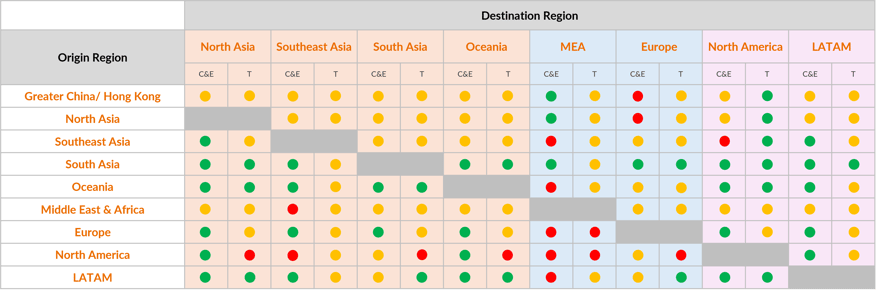
Ocean Freight Snapshot (May 2026)
Check our snapshot for a quick glance at space, rate, equipment, and transit times for Oceania.

Air Freight Updates
Gulf Hub Capacity: Partially Recovering, But Rates Remain Elevated
By mid-April, the air cargo market was showing some signs of partial recovery at Gulf hubs, but conditions remained a long way from normal. Emirates reported operating more than 50% of its scheduled flights following the UAE's opening of safe air corridors. Etihad resumed limited services. Qatar Airways Cargo through Doha, however, remained suspended throughout April, with no confirmed return timeline. The three Gulf carriers together represent approximately 13% of global air cargo capacity, and their continuing partial absence continues to exert upward pressure on rates and compress available capacity on Asia-Europe and India-to-North America corridors.
Market data through April reflected this environment. Global average air freight rates rose approximately 10% week on week in mid-March and have remained elevated. South Asia to North America and Europe rates climbed approximately 50% since the conflict began. Spot rates from the Middle East and South Asia jumped 22% week on week in mid-March to USD 4.37 per kilogram, up 58% year on year. Even on lanes less directly affected, the displacement of cargo from Gulf-connected services to direct alternatives has tightened space and lifted rates. Global air cargo capacity was running approximately 12% below pre-conflict levels in the weeks of most acute disruption, with Asia Pacific to Middle East lanes down around 40% on that comparison period.
Jet fuel costs, approximately double their year-ago level in some markets at the height of the oil price spike, have driven a sustained increase in Fuel Surcharges being reviewed and applied weekly rather than quarterly across most airlines. While oil prices have retreated from their March peak above USD 126 per barrel following diplomatic activity and ceasefire announcements, they remain elevated relative to 2025 levels, maintaining upward pressure on carrier operating costs and surcharge schedules.
What this means for Australia and New Zealand customers
- Australian importers using air freight for urgent cargo should expect elevated pricing and reduced schedule flexibility through Q2. Book early, confirm routing, and prepare documentation in advance to avoid clearance delays compounding extended transit times.
- The partial restoration of Gulf hub capacity means some recovery in space availability and routing options compared to early March, but the market is not back to pre-conflict conditions. Rates are likely to remain sticky at elevated levels as long as Qatar Airways Cargo remains suspended and uncertainty persists.
- For air freight into Australia that previously routed through Dubai or Doha, confirm with your forwarder that alternative routing via alternative hubs is pre-approved and that any service level agreements account for extended transit times.
Air Cargo Contract Season: Opportunity in a Volatile Market
The elevated and volatile air freight rate environment in Q1 and Q2 2026 has given shippers with regular air programmes an unusual opportunity. Where carriers have been redeploying freighter capacity away from disrupted trades toward more stable lanes, contract rates on some corridors have remained more stable than spot rates. Shippers who move from pure spot procurement to term agreements — even for shorter six to twelve month windows — may find that contract pricing offers meaningful protection against continued volatility, particularly if the Gulf disruption persists through Q3.
Xeneta's analysis of the 2026 air freight market suggests that supply exceeding demand on some lanes, even in a disrupted environment, is pushing carriers toward offering longer contracts to anchor volume commitments. For shippers in a position to commit reliable volumes, this is a negotiating window worth exploring.
What to do now: If you have regular, predictable air freight volumes on consistent corridors, ask your KLN Oceania account manager about contract rate options. The contrast between current spot volatility and the relative stability available through term agreements is more pronounced than usual, and the window for locking in rates before any further disruption-driven movements is open now.
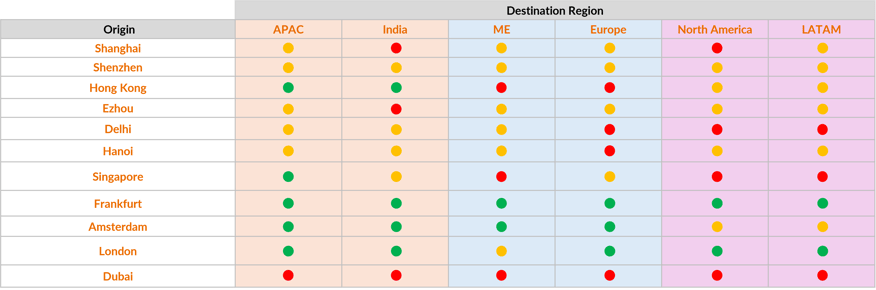
Air Freight Snapshot (May 2026)
Customs, Inland Transport, Terminal and Regulation Updates
NZ - Lyttleton: Emergency Dredging Campaign
Lyttelton Port Company has commenced an emergency dredging campaign to restore the main shipping channel following exceptional sediment infill caused by a series of extreme weather events. Since LPC's scheduled maintenance dredging was completed in November 2025, close to one million cubic metres of material have been deposited into the channel, well above the typical annual infill of 600,000 to 800,000 cubic metres.
The most significant single event occurred on 27 March 2026, when a subtropical low-pressure system deposited more than 430,000 cubic metres of sediment within days. In some areas, depth loss is now imposing tidal constraints on vessel access. LPC has deployed the Dutch dredging vessel Elbe to address high spots and restore safe channel depths. LPC expects the campaign to take three to four weeks from commencement in late April 2026. South Island cargo movements may experience delays or revised berthing windows during this period. Customers with time-sensitive or high-volume cargo through Lyttelton should engage their KLN Oceania account manager now to assess contingency options including air freight, alternative port routing, or adjusted cut-off planning.
AUS: Updated Inorganic Fertiliser Import Policy — Effective 30 April 2026
The Department of Agriculture, Fisheries and Forestry (DAFF) has issued updated import conditions and policy for inorganic (chemical and mined) fertilisers, effective 30 April 2026. The changes apply to both bulk cargo (shipped in vessel holds) and containerised fertiliser, and were formally notified to industry via Import Industry Advice Notice 56-2026 on 16 April 2026.
The updated policy introduces improved offshore certification requirements, meaning imported fertiliser will need to meet enhanced pre-load standards before arriving in Australia. Importers using higher-risk supply chain pathways will be required to provide samples for inspection, while registration and compliance processes have been simplified overall. Offshore manufacturers that hold or are seeking a reduced-risk classification with the department are encouraged to contact DAFF to expand their recognition to cover both bulk and containerised product under the new framework.
The changes are partly a response to ongoing global pressure on fertiliser supply — including disruptions affecting Gulf-origin shipments — and are designed to reduce port-side delays while maintaining Australia's biosecurity standards.
The transitional rule is clear: goods loaded prior to 30 April 2026 will be assessed under the import conditions that were in place at the time of this notice. Any goods loaded on or after 30 April must comply with the updated conditions.
What to do now: If you import inorganic fertilisers — including urea, phosphates, sulphur, or related mined or chemical products — review the updated policy documents on DAFF's Chemical and Mined Fertiliser webpage immediately. Confirm with your supplier whether offshore certification or sampling requirements apply to your specific product pathway, and brief your customs broker on the 30 April effective date. For any shipments currently on water, verify the loaded-on-board date to determine which conditions apply on arrival. If your offshore manufacturer holds a reduced-risk classification, check whether their recognition needs to be extended under the new policy ahead of shipment.
AUS: 2025–26 BMSB Season Officially Closed — Tail-End Obligations Remain
The 2025–26 Brown Marmorated Stink Bug (BMSB) risk season concluded on 1 May 2026. Goods shipped on board, or vessels departing from BMSB target risk countries, on or after 1 May 2026 are no longer subject to seasonal BMSB measures.
However, the season's close doesn't mean a clean break for all cargo. Any target high-risk goods manufactured in or shipped from risk countries with a shipped-on-board date between 1 September 2025 and 30 April 2026 remain subject to BMSB requirements regardless of when they arrive in Australia. If those shipments are still in transit, documentation and treatment compliance must be in order before arrival.
A few operational points remain active:
-
Ro-Ro vessels will continue to receive a Seasonal Pest Questionnaire as part of pre-arrival reporting through to 30 June 2026. Any Ro-Ro vessel that berthed, loaded, or transhipped from target risk countries between 1 September 2025 and 30 April 2026 — or that reports exotic pest concerns — is subject to a mandatory seasonal pest inspection on arrival. All vessel masters and agents must continue reporting insect detections in pre-arrival documentation.
-
Master consolidators must still lodge declarations for containers with a shipped-on-board date within the season window (1 September 2025 to 30 April 2026). For containers shipped on or after 1 May 2026, a NIL RISK declaration applies.
-
Class 19.2 AEPCOMM remains available to facilitate clearance of goods still subject to seasonal measures. For goods shipped from 1 May 2026 onwards, class 19.2 reverts to assessing standard biosecurity measures — accredited persons should refer to the Approved Commodities webpage and relevant BICON cases.
DAFF has also taken the opportunity to remind importers that biosecurity obligations do not lapse with the season. Goods must be free of biosecurity risk material year-round.
What to do now: Confirm the shipped-on-board date on any outstanding or in-transit consignments from BMSB risk countries. If dated before 1 May 2026, ensure treatment certificates and compliance documents are complete ahead of arrival. For Ro-Ro operators and agents, pre-arrival reporting obligations continue through June. Brief your team on the NIL RISK declaration process for new shipments from 1 May onwards.
AUS: New Fact Sheets Published for Methyl Bromide Fumigation Documentation
The Department of Agriculture, Fisheries and Forestry (DAFF) has published three new instructional fact sheets to assist treatment providers in correctly completing documentation for methyl bromide fumigations. The resources were notified to industry via Import Industry Advice Notice 61-2026, issued 28 April 2026.
The fact sheets provide step-by-step guidance on completing the required forms accurately. DAFF has been clear on the intent: documentation errors are a common cause of processing delays and refused biosecurity clearances, and these resources are designed to reduce that risk at the source.
The guidance is primarily aimed at treatment providers, but the downstream benefit flows directly to importers, customs brokers, and freight forwarders — any administrative error in fumigation documentation can hold up clearance for the whole consignment.
What to do now: If your supply chain involves methyl bromide fumigation — commonly used for timber, wooden packaging, or certain commodities requiring pre-export treatment — share these fact sheets with your treatment providers and confirm they are referencing the updated guidance. The resources are available on DAFF's methyl bromide fumigation guides and fact sheets webpage. For questions, contact the Compliance Partnerships Program at offshoretreatments@aff.gov.au.
Why Partner with KLN
Selecting KLN Oceania as your trusted partner isn't just a choice—it's a strategic move towards ensuring your success. Our commitment to excellence is not just a promise; it's a guarantee. With a global network that's both vast and meticulously managed, we stand head and shoulders above the competition. This means you benefit directly from unparalleled service quality, ensuring your supply chain needs are met with precision, efficiency, and minimal hassle.
Are you ready to elevate your logistics game and experience seamless support tailored to your unique needs? Let's discuss how we can bring unparalleled value to your business.