---
title: LCL Consolidation for Ocean Freight in 2026
description: Explore the essentials of LCL consolidation for ocean freight, including costs, processes, and how to optimize your shipping strategy for 2026.
image: https://info.oceania.kln.com/hubfs/LCL%20Shipping%20Journey%20Australia.png
---
[](https://oceania.kln.com)
- About us
- [Our Team](https://oceania.kln.com/about-us/team)
- [Oceania at a glance](https://oceania.kln.com/about-us/oceania-at-a-glance)
- [Sustainability](https://oceania.kln.com/about-us/sustainability)
- [Global network](https://oceania.kln.com/about-us/global-network)
- Content
- [KnowledgeHub](https://info.oceania.kln.com/knowledgehub)
- [Konnect](https://info.oceania.kln.com/konnect)
- [Customer Advisories](https://info.oceania.kln.com/customer-advisory)
- [Downloads & Resources](https://info.oceania.kln.com/downloads-resources1)
- Solutions
- [VBO - Supply Chain Command Center](https://info.oceania.kln.com/vbo)
- [KLN Online](https://info.oceania.kln.com/kln-online-solutions)
- Freight
- [Ocean Freight](https://info.oceania.kln.com/ocean-freight)
- [Air Freight](https://info.oceania.kln.com/air-freight)
- [Land Freight](https://oceania.kln.com/solutions/land-freight)
- [Multimodal](https://oceania.kln.com/solutions/multimodal)
- [Customs Brokerage](https://oceania.kln.com/solutions/customs-brokerage)
- [Cargo Insurance](https://info.oceania.kln.com/cargo-insurance)
- [Supply Chain Solutions](https://oceania.kln.com/solutions/supply-chain-solutions)
- [Consolidation](https://oceania.kln.com/solutions/consolidation)
- [Integrated Logistics](https://oceania.kln.com/solutions/integrated-logistics)
- Locations
- [Australia](https://oceania.kln.com/locations/australia)
- [Aotearoa New Zealand](https://oceania.kln.com/locations/aotearoa-new-zealand)
- [Global network](https://www.kln.com/en/network/)
- [Track & Trace](https://oceania.kln.com/track-trace)
- [Contact](https://info.oceania.kln.com/contact)
- [Subscribe](https://info.oceania.kln.com/subscribe-communications)
- About us
- [Our Team](https://oceania.kln.com/about-us/team)
- [Oceania at a glance](https://oceania.kln.com/about-us/oceania-at-a-glance)
- [Sustainability](https://oceania.kln.com/about-us/sustainability)
- [Global network](https://oceania.kln.com/about-us/global-network)
- Content
- [KnowledgeHub](https://info.oceania.kln.com/knowledgehub)
- [Konnect](https://info.oceania.kln.com/konnect)
- [Customer Advisories](https://info.oceania.kln.com/customer-advisory)
- [Downloads & Resources](https://info.oceania.kln.com/downloads-resources1)
- Solutions
- [VBO - Supply Chain Command Center](https://info.oceania.kln.com/vbo)
- [KLN Online](https://info.oceania.kln.com/kln-online-solutions)
- Freight
- [Ocean Freight](https://info.oceania.kln.com/ocean-freight)
- [Air Freight](https://info.oceania.kln.com/air-freight)
- [Land Freight](https://oceania.kln.com/solutions/land-freight)
- [Multimodal](https://oceania.kln.com/solutions/multimodal)
- [Customs Brokerage](https://oceania.kln.com/solutions/customs-brokerage)
- [Cargo Insurance](https://info.oceania.kln.com/cargo-insurance)
- [Supply Chain Solutions](https://oceania.kln.com/solutions/supply-chain-solutions)
- [Consolidation](https://oceania.kln.com/solutions/consolidation)
- [Integrated Logistics](https://oceania.kln.com/solutions/integrated-logistics)
- Locations
- [Australia](https://oceania.kln.com/locations/australia)
- [Aotearoa New Zealand](https://oceania.kln.com/locations/aotearoa-new-zealand)
- [Global network](https://www.kln.com/en/network/)
- [Track & Trace](https://oceania.kln.com/track-trace)
- [Contact](https://info.oceania.kln.com/contact)
- [Subscribe](https://info.oceania.kln.com/subscribe-communications)
- [Home](https://kerrylogisticsoceania.com/)
- [Articles](https://info.oceania.kln.com/knowledgehub)
- [Freight Forwarding Tips](https://info.oceania.kln.com/knowledgehub/tag/freight-forwarding-tips)
# LCL Consolidation for Ocean Freight in 2026
09 Jul 2026
[Freight Forwarding Tips](https://info.oceania.kln.com/knowledgehub/tag/freight-forwarding-tips) [International Trade](https://info.oceania.kln.com/knowledgehub/tag/international-trade) [FCL](https://info.oceania.kln.com/knowledgehub/tag/fcl) [General Knowledge](https://info.oceania.kln.com/knowledgehub/tag/general-knowledge) [Customs Brokerage](https://info.oceania.kln.com/knowledgehub/tag/customs-brokerage) [2026](https://info.oceania.kln.com/knowledgehub/tag/2026)
- [](http://www.facebook.com/sharer/sharer.php?u=https://info.oceania.kln.com/knowledgehub/lcl-consolidation-for-ocean-freight-in-2026)
- [](https://twitter.com/intent/tweet?url=https://info.oceania.kln.com/knowledgehub/lcl-consolidation-for-ocean-freight-in-2026&text=LCL%20Consolidation%20for%20Ocean%20Freight%20in%202026)
- [](http://www.linkedin.com/shareArticle?mini=true&url=https://info.oceania.kln.com/knowledgehub/lcl-consolidation-for-ocean-freight-in-2026)
- [](mailto:?body=https://info.oceania.kln.com/knowledgehub/lcl-consolidation-for-ocean-freight-in-2026)
- Copy to clipboardLink Copied
https://info.oceania.kln.com/knowledgehub/lcl-consolidation-for-ocean-freight-in-2026

☰ On this page
On this page
×
↑ Back to top
‹
Moving international cargo without filling an entire container can feel like a costly puzzle. If your shipments typically run between 1 and 15 cubic metres, you're likely paying for space you don't need—or scrambling to find cost-effective alternatives. KLN Freight (Oceania) helps mid-sized supply chain teams navigate LCL consolidation with tailored ocean freight solutions that keep costs predictable and inventory flowing.
This guide walks you through everything you need to know about LCL consolidation strategy for international ocean cargo transport. You'll learn when to choose LCL over full container load (FCL), how the consolidation process works, what costs to expect, and how to coordinate customs clearance across multiple origins.
## Key Takeaways: LCL Consolidation for Ocean Freight in 2026
- LCL consolidation allows you to share container space with other shippers, paying only for the cubic metres your cargo occupies.
- The 15 CBM threshold typically determines whether LCL or FCL is more cost-effective for your shipment.
- KLN Freight (Oceania) offers end-to-end LCL services with real-time tracking and customs brokerage support across Australia and New Zealand.
- Transit times for LCL shipments include consolidation and deconsolidation phases, adding 5 to 10 days compared to FCL.
- Accurate cargo measurements and proper documentation are essential to avoid unexpected fees and customs delays.
## What Is LCL Consolidation in Ocean Freight?
LCL stands for Less than Container Load. It's a shipping method where multiple shippers share space within a single ocean freight container. Instead of booking an entire 20-foot or 40-foot container, you pay only for the volume your cargo occupies—measured in cubic metres (CBM).
A freight forwarder or consolidator collects shipments from various businesses at a Container Freight Station (CFS). These individual consignments are then loaded together into one container bound for the same destination port. At the arrival port, the container is deconsolidated, and each shipment is separated for final delivery.
This method works particularly well for mid-sized businesses that need to move inventory regularly but don't generate enough volume to justify exclusive container use. It's also a practical solution when you're testing new markets, launching products, or managing seasonal demand fluctuations.
## How Does the LCL Consolidation Process Work?
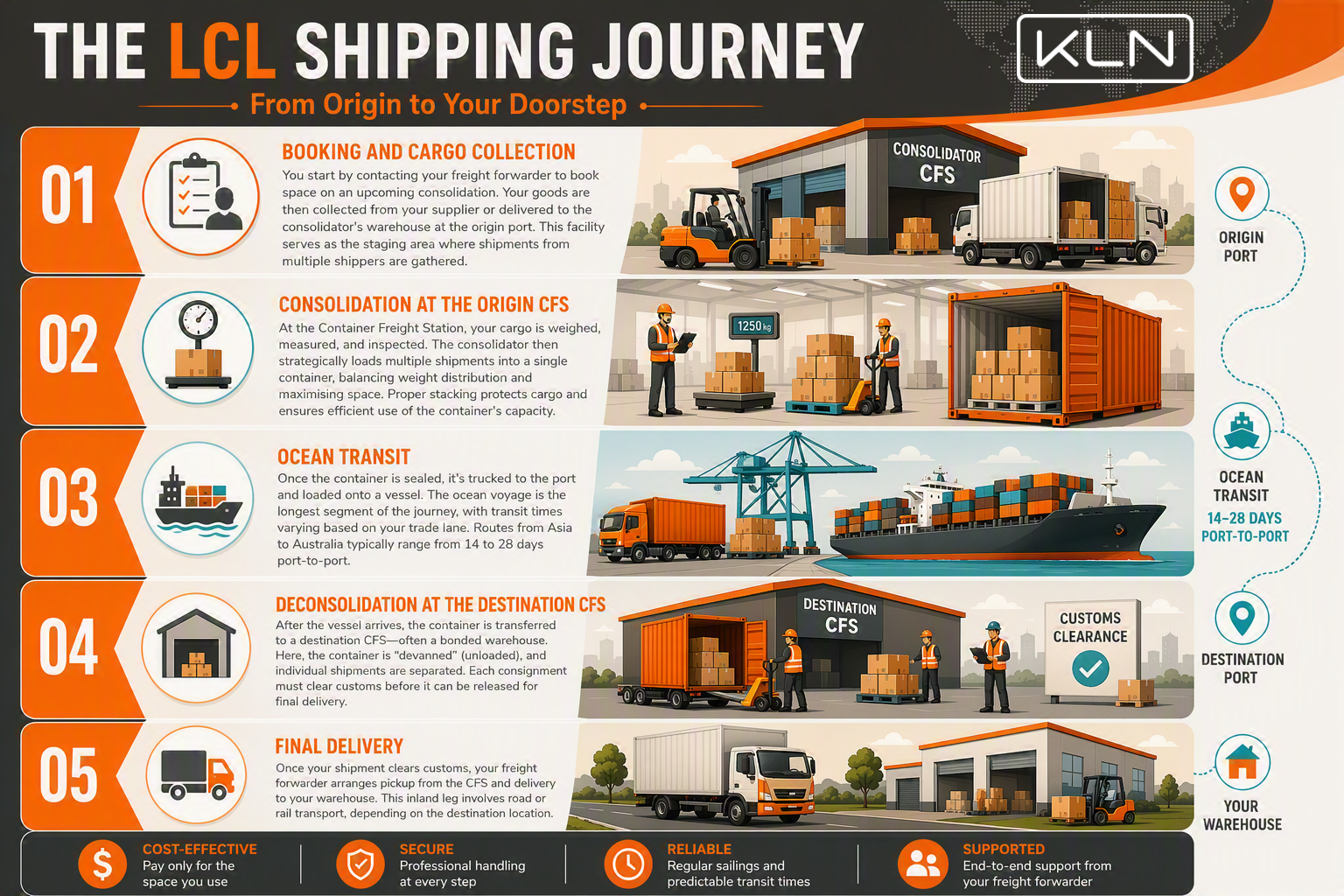
Understanding the physical journey of your LCL cargo helps you plan realistic timelines and avoid surprises at the destination. Here's how a typical LCL shipment moves from origin to your warehouse.
### Booking and Cargo Collection
You start by contacting your freight forwarder to book space on an upcoming consolidation. Your goods are then collected from your supplier or delivered to the consolidator's warehouse at the origin port. This facility serves as the staging area where shipments from multiple shippers are gathered.
### Consolidation at the Origin CFS
At the Container Freight Station, your cargo is weighed, measured, and inspected. The consolidator then strategically loads multiple shipments into a single container, balancing weight distribution and maximising space. Proper stacking protects cargo and ensures efficient use of the container's capacity.
### Ocean Transit
Once the container is sealed, it's trucked to the port and loaded onto a vessel. The ocean voyage is the longest segment of the journey, with transit times varying based on your trade lane. Routes from Asia to Australia typically range from 14 to 28 days port-to-port.
### Deconsolidation at the Destination CFS
After the vessel arrives, the container is transferred to a destination CFS—often a bonded warehouse. Here, the container is "devanned" (unloaded), and individual shipments are separated. Each consignment must clear customs before it can be released for final delivery.
### Final Delivery
Once your shipment clears customs, your freight forwarder arranges pickup from the CFS and delivery to your warehouse. This inland leg involves road or rail transport, depending on the destination location.
## [](https://info.oceania.kln.com/hs/cta/wi/redirect?encryptedPayload=AVxigLJxNTwhW8cPAIGiXxI7hb39DXm%2FcWSUG7D7Z%2B3Pl9KkEU802aPBzMMtdJXAr6Q7os%2Bqaet7gXi7T%2F055XjoFn2JHpvHf9Y4MnygBJm8wJgtlNMbjY2IWCWWGFb5yNlDu8qqnXxp%2B2kcNri61YILd7VqIh6wE42UgzjQzX4HYZ3JgUlI7VrV%2BpUWNWN9tZIrrQSE3zTq3XMxDnrm&webInteractiveContentId=148519118772&portalId=40234550)
## When Should You Choose LCL Over FCL?
The decision between LCL and FCL typically comes down to volume, cost, and timing. Here's a practical framework to guide your choice.
### The 15 CBM Rule
If your shipment measures less than 15 cubic metres, LCL is almost always more economical. You're paying for actual space used rather than an entire container. Once your volume exceeds 15 CBM, the flat rate for a 20-foot container often becomes more cost-effective because LCL fees are charged per unit of volume.
### Shipment Frequency and Volume Variability
LCL suits businesses with fluctuating shipping volumes. If your order patterns vary month to month, waiting to accumulate enough inventory for a full container ties up working capital and delays stock replenishment. More frequent, smaller LCL shipments keep inventory moving and cash flow healthier.
### Product Testing and New Market Entry
When launching products or entering new markets, demand is unproven. Committing to a full container load represents significant financial risk if sales don't materialise as expected. LCL lets you test the waters with smaller quantities before scaling up.
### Time Sensitivity Considerations
LCL shipments require additional handling at both origin and destination. This typically adds 5 to 10 days to the total transit time compared to FCL. If your cargo is time-sensitive, factor this into your planning. For urgent shipments, air freight may be necessary despite the higher cost.
[](https://info.oceania.kln.com/hs/cta/wi/redirect?encryptedPayload=AVxigLJxNTwhW8cPAIGiXxI7hb39DXm%2FcWSUG7D7Z%2B3Pl9KkEU802aPBzMMtdJXAr6Q7os%2Bqaet7gXi7T%2F055XjoFn2JHpvHf9Y4MnygBJm8wJgtlNMbjY2IWCWWGFb5yNlDu8qqnXxp%2B2kcNri61YILd7VqIh6wE42UgzjQzX4HYZ3JgUlI7VrV%2BpUWNWN9tZIrrQSE3zTq3XMxDnrm&webInteractiveContentId=148519118772&portalId=40234550)
## What Are the Costs Involved in LCL Shipping?
LCL pricing can seem complex at first glance, but it follows a consistent structure. Understanding these cost components helps you budget accurately and avoid unexpected charges.
### Ocean Freight Rates
LCL rates are typically quoted per W/M (weight or measure), meaning you're charged based on whichever is greater—the actual weight or the volumetric measurement of your cargo. The standard conversion is 1 CBM equals 1,000 kg. If your shipment is bulky but lightweight, volume drives the cost. If it's compact but heavy, weight determines your rate.
### Origin CFS Charges
These fees cover receiving, handling, and loading your cargo at the origin warehouse. They include inspection, measurement verification, and container stuffing. Expect to see line items for CFS receiving, handling, and documentation at origin.
### Destination CFS Charges
The destination leg often carries higher charges than shippers anticipate. Fees cover container devanning, cargo sorting, storage, and release documentation. Australian ports have specific Terminal Handling Charges (THC) that apply to incoming containers.
### Documentation Fees
Your shipment requires a House Bill of Lading (HBL), which serves as your contract of carriage and title to goods. Documentation fees cover the administrative work of preparing shipping paperwork and coordinating with customs authorities.
### Customs Brokerage
Importing goods into Australia requires formal customs clearance. A licensed customs broker files your entry, classifies your goods under the correct tariff codes, and manages any duty payments. KLN Freight (Oceania) offers integrated customs brokerage services to streamline this process.
### Pickup and Delivery
Door-to-door LCL costs include trucking from your supplier to the origin CFS and from the destination CFS to your warehouse. These inland transport legs are often quoted separately from the ocean freight portion.
[](https://info.oceania.kln.com/hs/cta/wi/redirect?encryptedPayload=AVxigLJxNTwhW8cPAIGiXxI7hb39DXm%2FcWSUG7D7Z%2B3Pl9KkEU802aPBzMMtdJXAr6Q7os%2Bqaet7gXi7T%2F055XjoFn2JHpvHf9Y4MnygBJm8wJgtlNMbjY2IWCWWGFb5yNlDu8qqnXxp%2B2kcNri61YILd7VqIh6wE42UgzjQzX4HYZ3JgUlI7VrV%2BpUWNWN9tZIrrQSE3zTq3XMxDnrm&webInteractiveContentId=148519118772&portalId=40234550)
## How Do You Calculate Cargo Volume for LCL?
Accurate volume calculation prevents billing surprises and helps you compare quotes effectively. Here's how to measure your cargo correctly.
### The CBM Formula
Calculate cubic metres by multiplying length × width × height in metres. For example, a pallet measuring 1.2m × 1.0m × 1.5m equals 1.8 CBM. If you have multiple packages, calculate each one and sum the totals.
### Accounting for Irregular Shapes
For irregularly shaped cargo, measure the maximum dimensions of each piece. Carriers bill based on the space your cargo occupies within the container, not the actual product dimensions. If your goods have protrusions or irregular shapes, they take up more space than a simple box calculation would suggest.
### Weight Versus Volume
Remember the W/M rule: you're charged for whichever is greater. Dense, heavy products may be billed by weight, while lightweight but bulky items are billed by volume. Calculate both to understand which applies to your cargo.
[](https://info.oceania.kln.com/hs/cta/wi/redirect?encryptedPayload=AVxigLJxNTwhW8cPAIGiXxI7hb39DXm%2FcWSUG7D7Z%2B3Pl9KkEU802aPBzMMtdJXAr6Q7os%2Bqaet7gXi7T%2F055XjoFn2JHpvHf9Y4MnygBJm8wJgtlNMbjY2IWCWWGFb5yNlDu8qqnXxp%2B2kcNri61YILd7VqIh6wE42UgzjQzX4HYZ3JgUlI7VrV%2BpUWNWN9tZIrrQSE3zTq3XMxDnrm&webInteractiveContentId=148519118772&portalId=40234550)
## What Transit Times Can You Expect for LCL Shipments?
LCL transit times include several phases beyond the ocean voyage itself. Planning realistic timelines helps you manage inventory levels and customer expectations.
### Consolidation Phase
Before your cargo sails, it must be received at the origin CFS and wait for the consolidator to build a full container load. This phase typically takes 3 to 7 days, depending on the consolidation schedule for your trade lane and the forwarder's sailing frequency.
### Ocean Transit
The port-to-port voyage varies significantly by route. Major trade lanes from Asia to Australia range from 14 to 28 days, with variations based on specific port pairs, transshipment requirements, and carrier schedules.
### Deconsolidation and Customs
After arrival, the container moves to a CFS for devanning. Your shipment must then clear customs before release. This phase typically adds 3 to 7 days, though delays can occur if documentation is incomplete or if cargo is selected for inspection.
### Final Delivery
The last-mile leg from CFS to your warehouse adds 1 to 5 days depending on location, truck availability, and receiving appointment schedules.
### Total Door-to-Door Estimate
For Asia-to-Australia LCL shipments, budget approximately 30 to 50 days door-to-door. This range accounts for normal consolidation cycles, ocean transit, customs processing, and inland delivery. Building buffer time into your planning helps absorb unexpected delays.
[](https://info.oceania.kln.com/hs/cta/wi/redirect?encryptedPayload=AVxigLJxNTwhW8cPAIGiXxI7hb39DXm%2FcWSUG7D7Z%2B3Pl9KkEU802aPBzMMtdJXAr6Q7os%2Bqaet7gXi7T%2F055XjoFn2JHpvHf9Y4MnygBJm8wJgtlNMbjY2IWCWWGFb5yNlDu8qqnXxp%2B2kcNri61YILd7VqIh6wE42UgzjQzX4HYZ3JgUlI7VrV%2BpUWNWN9tZIrrQSE3zTq3XMxDnrm&webInteractiveContentId=148519118772&portalId=40234550)
## What Documentation Do You Need for LCL Customs Clearance?
Proper documentation is critical for smooth customs clearance. Missing or incorrect paperwork causes delays that can result in storage fees at the destination CFS. Prepare these documents before your cargo ships.
### Commercial Invoice
This document describes the transaction between buyer and seller. It must include accurate product descriptions, quantities, unit values, and total values. Customs authorities use this information to assess duties and verify the declared goods.
### Packing List
The packing list details how goods are packed—number of cartons, pallets, or pieces, along with dimensions and weights. It should match the commercial invoice and help customs officers verify the shipment contents.
### Bill of Lading
For LCL shipments, you'll receive a House Bill of Lading (HBL) from your freight forwarder. This serves as your receipt for cargo delivered to the carrier, your contract of carriage, and your document of title. Keep this safe—you'll need it to claim your goods at destination.
### Certificate of Origin
Depending on your products and trade agreements, you may need a Certificate of Origin to qualify for preferential tariff rates. Australia has free trade agreements with many Asian countries that can reduce or eliminate duties on qualifying goods.
### Import Permits and Licences
Certain products require specific permits before importation. Biosecurity is particularly important in Australia—some goods need inspection or treatment to meet quarantine requirements. Check with your customs broker about any permits your products may require.
[](https://info.oceania.kln.com/hs/cta/wi/redirect?encryptedPayload=AVxigLJxNTwhW8cPAIGiXxI7hb39DXm%2FcWSUG7D7Z%2B3Pl9KkEU802aPBzMMtdJXAr6Q7os%2Bqaet7gXi7T%2F055XjoFn2JHpvHf9Y4MnygBJm8wJgtlNMbjY2IWCWWGFb5yNlDu8qqnXxp%2B2kcNri61YILd7VqIh6wE42UgzjQzX4HYZ3JgUlI7VrV%2BpUWNWN9tZIrrQSE3zTq3XMxDnrm&webInteractiveContentId=148519118772&portalId=40234550)
## How Can You Reduce Risk in Shared Container Shipping?
Sharing container space with other shippers introduces specific risks that don't apply to FCL. Understanding these risks helps you take precautions to protect your cargo.
### Packaging for Multiple Handling
LCL cargo is handled more frequently than FCL shipments—it's loaded at origin, potentially restacked during consolidation, unloaded at destination, and separated during deconsolidation. Use sturdy packaging that can withstand multiple handling events. Consider double-walled corrugated cartons, internal cushioning, and proper palletisation.
### Palletisation Requirements
Wooden pallets used in international shipping must comply with ISPM 15 standards, meaning they've been heat-treated to prevent pest transmission. Using non-compliant pallets can result in rejection at the destination port. Mark pallets clearly and ensure they're sturdy enough to support stacking.
### Clear Labelling
Every piece of cargo needs waterproof, durable labels with shipping marks, consignee details, and handling instructions. Clear labelling prevents misdirection during the deconsolidation process and helps CFS workers identify your cargo quickly.
### Cargo Insurance
Standard carrier liability coverage is often limited—sometimes as low as $2 per kilogram. For valuable cargo, arrange separate marine insurance that covers the full replacement value. Your freight forwarder can help you obtain appropriate coverage based on your cargo value and risk tolerance.
### The "One Bad Apple" Risk
If another shipment in your container is flagged for customs inspection, the entire container may be held. While you can't control other shippers' documentation, you can minimise your own risk by working with reputable forwarders who vet co-loaders carefully. KLN Freight (Oceania) pre-clears documentation and coordinates with trusted consolidation partners to reduce inspection delays.
[](https://info.oceania.kln.com/hs/cta/wi/redirect?encryptedPayload=AVxigLJxNTwhW8cPAIGiXxI7hb39DXm%2FcWSUG7D7Z%2B3Pl9KkEU802aPBzMMtdJXAr6Q7os%2Bqaet7gXi7T%2F055XjoFn2JHpvHf9Y4MnygBJm8wJgtlNMbjY2IWCWWGFb5yNlDu8qqnXxp%2B2kcNri61YILd7VqIh6wE42UgzjQzX4HYZ3JgUlI7VrV%2BpUWNWN9tZIrrQSE3zTq3XMxDnrm&webInteractiveContentId=148519118772&portalId=40234550)
## How Do You Coordinate LCL Shipments From Multiple Origins?
Many mid-sized businesses source from multiple countries. Coordinating LCL shipments from different origins requires careful planning to align inventory arrivals and manage customs across jurisdictions.
### Multi-Country Consolidation Strategies
Some freight forwarders offer buyer's consolidation services, gathering shipments from multiple suppliers in a region before shipping to your destination. This can reduce per-unit shipping costs and simplify receiving at your warehouse.
### Timing Considerations
When sourcing from multiple origins, production and shipping schedules rarely align perfectly. Build flexibility into your inventory planning to accommodate different transit times from each origin. Work with your forwarder to identify consolidation opportunities that don't significantly delay faster shipments.
### Documentation Coordination
Each origin requires its own set of export documentation. Coordinate with suppliers to ensure commercial invoices, packing lists, and certificates of origin are prepared consistently. Standardised documentation makes customs clearance smoother and reduces the risk of errors.
[](https://info.oceania.kln.com/hs/cta/wi/redirect?encryptedPayload=AVxigLJxNTwhW8cPAIGiXxI7hb39DXm%2FcWSUG7D7Z%2B3Pl9KkEU802aPBzMMtdJXAr6Q7os%2Bqaet7gXi7T%2F055XjoFn2JHpvHf9Y4MnygBJm8wJgtlNMbjY2IWCWWGFb5yNlDu8qqnXxp%2B2kcNri61YILd7VqIh6wE42UgzjQzX4HYZ3JgUlI7VrV%2BpUWNWN9tZIrrQSE3zTq3XMxDnrm&webInteractiveContentId=148519118772&portalId=40234550)
## What Role Does Technology Play in Modern LCL Shipping?
Digital tools have transformed LCL shipping from a black-box process into a transparent, trackable operation. Modern logistics platforms offer capabilities that weren't available even a few years ago. [Our VBO solution tackles this: instead of managing the process, you can start managing exceptions.](https://info.oceania.kln.com/vbo)
### Real-Time Shipment Tracking
Most freight forwarders now offer online tracking portals where you can monitor your shipment's status at key milestones. You can see when cargo is received at the origin CFS, when the container departs, vessel arrival times, and customs clearance status. KLN Freight (Oceania) offers AI-powered tracking and smart analytics that give you shipment-level visibility and exception alerts.
### Digital Documentation
Electronic Bills of Lading (eBL) are gaining adoption, reducing the paper chase that traditionally accompanied international shipping. Digital documentation speeds up customs processing and reduces the risk of lost paperwork.
### Predictive Analytics
Advanced logistics providers use historical data to predict potential delays—whether from port congestion, weather events, or seasonal capacity constraints. These insights help you plan inventory buffers and communicate proactively with customers about delivery expectations.
[](https://info.oceania.kln.com/hs/cta/wi/redirect?encryptedPayload=AVxigLJxNTwhW8cPAIGiXxI7hb39DXm%2FcWSUG7D7Z%2B3Pl9KkEU802aPBzMMtdJXAr6Q7os%2Bqaet7gXi7T%2F055XjoFn2JHpvHf9Y4MnygBJm8wJgtlNMbjY2IWCWWGFb5yNlDu8qqnXxp%2B2kcNri61YILd7VqIh6wE42UgzjQzX4HYZ3JgUlI7VrV%2BpUWNWN9tZIrrQSE3zTq3XMxDnrm&webInteractiveContentId=148519118772&portalId=40234550)
## How Do Seasonal Factors Affect LCL Availability and Pricing?
Ocean freight markets experience significant seasonal fluctuations. Understanding these patterns helps you plan shipments more effectively and manage costs.
### Peak Season Surcharges
The months leading up to major retail seasons—particularly August through November—see increased demand and higher rates. Peak Season Surcharges (PSS) can add significantly to your shipping costs during these periods. If possible, ship earlier to avoid peak pricing.
### Chinese New Year and Golden Week
Factory closures during Chinese New Year (typically late January or early February) and Golden Week (early October) disrupt supply chains from China. Plan shipments well before these periods to avoid production delays and the post-holiday capacity crunch. The weeks immediately after these holidays often see equipment shortages and elevated rates.
### Capacity Constraints
Container availability varies throughout the year and across trade lanes. During tight capacity periods, securing LCL space requires earlier booking and may involve premium rates. Building relationships with reliable forwarders helps ensure access to capacity when the market tightens.
## What Are Common LCL Shipping Mistakes to Avoid?
Learning from common pitfalls saves time, money, and frustration. Here are the mistakes we see most frequently—and how to prevent them.
### Inaccurate Cargo Measurements
Misdeclared dimensions lead to rebilling when your cargo is re-measured at the CFS. Measure carefully at the source, account for packaging materials and pallets, and provide accurate figures to your forwarder. The small effort of precise measurement prevents billing disputes later.
### Incomplete Documentation
Missing or incorrect paperwork causes customs delays that trigger storage fees. Prepare all documents before shipment, double-check product descriptions and values, and ensure everything matches across your commercial invoice, packing list, and bill of lading.
### Waiting Too Long to Book
LCL consolidations operate on schedules. Booking at the last minute may mean missing the next sailing or paying premium rates for expedited handling. Plan your shipping needs in advance and book early, especially during peak seasons.
### Ignoring Free Time Limits
Destination CFS facilities offer limited free time for storage after your cargo is available for pickup. After free time expires, storage charges accumulate quickly—often on a daily basis. Arrange pickup promptly and ensure your customs clearance is ready before cargo arrives.
### Underestimating Total Transit Time
Quoting port-to-port transit times to customers sets unrealistic expectations. Remember that LCL door-to-door times include consolidation, ocean transit, deconsolidation, customs, and final delivery. Communicate realistic timelines to avoid disappointing customers.
## Why Partner With an Experienced LCL Provider?
Navigating LCL consolidation successfully requires expertise across freight forwarding, customs compliance, and supply chain coordination. The right partner simplifies complexity and helps you optimise costs.
### Carrier Relationships and Network Access
Established forwarders maintain relationships with multiple carriers and consolidators, giving you access to capacity and competitive rates. KLN Freight (Oceania) operates a global network with capacity commitments from carrier partners, helping secure space even during tight market conditions.
### Integrated Customs Services
Customs clearance is where many shipments encounter delays. Working with a forwarder that offers in-house customs brokerage ensures documentation is prepared correctly from the start. KLN Freight (Oceania) holds Australian Trusted Trader accreditation, which can expedite border processing for qualifying shipments.
### Local Market Expertise
Understanding local port operations, regulatory requirements, and inland transport options makes a significant difference in service quality. Our Australia-based teams have deep knowledge of local markets across the region, helping you navigate requirements specific to each port and product category.
### End-to-End Visibility
Managing multiple vendors across the shipping process creates information gaps. Integrated providers coordinate the entire journey, giving you a single point of contact and consistent visibility from origin to final delivery.
[](https://info.oceania.kln.com/hs/cta/wi/redirect?encryptedPayload=AVxigLJxNTwhW8cPAIGiXxI7hb39DXm%2FcWSUG7D7Z%2B3Pl9KkEU802aPBzMMtdJXAr6Q7os%2Bqaet7gXi7T%2F055XjoFn2JHpvHf9Y4MnygBJm8wJgtlNMbjY2IWCWWGFb5yNlDu8qqnXxp%2B2kcNri61YILd7VqIh6wE42UgzjQzX4HYZ3JgUlI7VrV%2BpUWNWN9tZIrrQSE3zTq3XMxDnrm&webInteractiveContentId=148519118772&portalId=40234550)
## Building Your LCL Consolidation Strategy
LCL consolidation offers mid-sized supply chain teams a flexible, cost-effective way to move international ocean cargo without the commitment of full container loads. The key to success lies in understanding when LCL makes sense for your business, calculating volumes accurately, preparing documentation thoroughly, and partnering with experienced providers who can navigate the complexities on your behalf.
For shipments under 15 CBM, LCL typically delivers significant cost savings compared to FCL. It supports more agile inventory management, reduces working capital tied up in stock, and provides a lower-risk pathway into new markets. The trade-off in handling time and transit complexity is manageable when you plan appropriately and work with knowledgeable partners.
Whether you're managing regular inventory replenishment or exploring new sourcing regions, KLN Freight (Oceania) offers the ocean freight, customs brokerage, and supply chain solutions to support your international shipping needs. Our team combines global network reach with local expertise across Australia and New Zealand, helping you move cargo reliably and cost-effectively.
## FAQs About LCL Consolidation for Ocean Freight
### What is the minimum shipment size for LCL ocean freight?
Most carriers apply a minimum billable volume of 1 CBM for LCL shipments. You can ship cargo smaller than 1 CBM, but you'll be charged the 1 CBM minimum rate. This floor covers the fixed costs of documentation, customs entry, and CFS handling that apply regardless of shipment size.
### How much does LCL shipping cost compared to FCL?
For shipments under 15 CBM, LCL typically costs 40-60% less than booking a full container because you pay only for the space you use. Once your volume exceeds roughly 15 CBM, FCL often becomes more economical because you're spreading a flat container rate across more cubic metres.
### How long does LCL shipping take from Asia to Australia?
Door-to-door LCL shipments from major Asian ports to Australia typically take 30 to 50 days. This includes 3-7 days for origin consolidation, 14-28 days of ocean transit depending on the specific route, 3-7 days for destination deconsolidation and customs clearance, and 1-5 days for final delivery.
### Can temperature-sensitive goods be shipped via LCL?
Standard LCL consolidation uses dry containers without climate control. Temperature-sensitive products like food, pharmaceuticals, or certain chemicals typically require refrigerated (reefer) containers. KLN Freight (Oceania) offers cold chain logistics solutions for temperature-controlled cargo—contact our team to discuss your specific requirements.
### What happens if my LCL shipment is delayed at customs?
Customs delays can result from documentation errors, cargo inspections, or holds on other shipments in the same container. While your cargo waits, storage fees accumulate at the CFS. Working with a freight forwarder that offers integrated customs brokerage—like KLN Freight (Oceania)—helps prevent documentation issues and expedites release when delays occur.
### How does KLN Freight (Oceania) support LCL shipments?
KLN Freight (Oceania) offers end-to-end LCL services including freight booking, origin coordination, ocean transport, customs brokerage, and final delivery across Australia and New Zealand. Our Australian Trusted Trader status, AI-powered tracking tools, and experienced local teams help ensure your LCL shipments move smoothly from supplier to warehouse.
### Why Partner with KLN (formerly Kerry Logistics Network)
Selecting KLN as your trusted partner isn't just a choice—it's a strategic move towards ensuring your success. Our commitment to excellence is not just a promise; it's a guarantee. With a global network that's both vast and meticulously managed, we stand head and shoulders above the competition. This means you benefit directly from unparalleled service quality, ensuring your supply chain needs are met with precision, efficiency, and minimal hassle.
Are you ready to elevate your logistics game and experience seamless support tailored to your unique needs? Let's discuss how we can bring unparalleled value to your business.
[](https://info.oceania.kln.com/hs/cta/wi/redirect?encryptedPayload=AVxigLJxNTwhW8cPAIGiXxI7hb39DXm%2FcWSUG7D7Z%2B3Pl9KkEU802aPBzMMtdJXAr6Q7os%2Bqaet7gXi7T%2F055XjoFn2JHpvHf9Y4MnygBJm8wJgtlNMbjY2IWCWWGFb5yNlDu8qqnXxp%2B2kcNri61YILd7VqIh6wE42UgzjQzX4HYZ3JgUlI7VrV%2BpUWNWN9tZIrrQSE3zTq3XMxDnrm&webInteractiveContentId=148519118772&portalId=40234550)

## Related articles
[View All](https://info.oceania.kln.com/knowledgehub)
[Customs](https://info.oceania.kln.com/knowledgehub/tag/customs) [FCL or LCL? How Mid-Sized Importers Choose Ocean Freight](https://info.oceania.kln.com/knowledgehub/fcl-vs-lcl-ocean-freight-suitability)
24 Sep 2026
[Ocean Freight](https://info.oceania.kln.com/knowledgehub/tag/ocean-freight) [Golden Week 2026 Shipping Guide: Dates, Delays and Booking Deadlines for AU & NZ Importers](https://info.oceania.kln.com/knowledgehub/golden-week-2026-shipping-guide-dates-delays-and-booking-deadlines-for-au-nz-importers)
03 Sep 2026
[Customs](https://info.oceania.kln.com/knowledgehub/tag/customs) [Ultimate Guide To 2026/27 Stink Bug Season (BMSB): Season Measures for Australia & New Zealand Importers](https://info.oceania.kln.com/knowledgehub/guide-to-2026/27-stink-bug-season-bmsb)
25 Aug 2026
[Customs](https://info.oceania.kln.com/knowledgehub/tag/customs) [How to Choose an Ocean Freight Forwarder in Australia (2026 Guide)](https://info.oceania.kln.com/knowledgehub/how-to-choose-an-ocean-freight-forwarder-in-australia-2026-guide)
29 Jun 2026
[Customs](https://info.oceania.kln.com/knowledgehub/tag/customs) [How to Choose an Ocean Freight Forwarder in New Zealand (2026 Guide)](https://info.oceania.kln.com/knowledgehub/how-to-choose-an-ocean-freight-forwarder-in-new-zealand-2026-guide)
08 Jun 2026
[Customs](https://info.oceania.kln.com/knowledgehub/tag/customs) [Is the Strait of Hormuz Open? Israel-Iran Shipping Impact Explained](https://info.oceania.kln.com/knowledgehub/israel-iran-tensions)
10 Mar 2026
[Ocean Freight](https://info.oceania.kln.com/knowledgehub/tag/ocean-freight) [Chinese New Year 2026: Supply Chain Disruption Risks and Planning Guide](https://info.oceania.kln.com/knowledgehub/chinese-new-year-2026)
19 Jan 2026
[Ocean Freight](https://info.oceania.kln.com/knowledgehub/tag/ocean-freight) [CHINA'S GOLDEN WEEK 2025](https://info.oceania.kln.com/knowledgehub/golden-week-2025)
18 Sep 2025
### Notices
### Company
### Locations
Connect with KLN Oceania
[](https://www.linkedin.com/company/29366171/)
[](https://www.kln.com/)
© 2026 KLN FREIGHT (OCEANIA) LIMITED. ALL RIGHTS RESERVED.
- [Trading terms](https://oceania.kln.com/legal/trading-terms/)
- [Terms & conditions of use](https://oceania.kln.com/legal/terms-conditions-of-use/)
- [Privacy policy](https://oceania.kln.com/legal/privacy-policy/)
- [Disclaimer](https://oceania.kln.com/legal/disclaimer/)
```json
{
"@context" : "https://schema.org",
"@type" : "BlogPosting",
"author" : {
"@type" : "Person",
"name" : "KLN Oceania",
"url" : "https://info.oceania.kln.com/knowledgehub/author/kln-oceania"
},
"dateModified" : "2026-07-09T00:34:54.461Z",
"datePublished" : "2026-07-09T00:32:25.000Z",
"headline" : "LCL Consolidation for Ocean Freight in 2026",
"image" : [ "https://info.oceania.kln.com/hubfs/LCL%20Shipping%20Journey%20Australia.png" ],
"mainEntityOfPage" : {
"@id" : "https://info.oceania.kln.com/knowledgehub/lcl-consolidation-for-ocean-freight-in-2026",
"@type" : "WebPage"
},
"publisher" : {
"@type" : "Organization",
"logo" : {
"@type" : "ImageObject",
"url" : "https://info.oceania.kln.com/hubfs/KLN%20Logo_colour.jpg"
},
"name" : "KLN FREIGHT (OCEANIA) PTY. LTD."
}
}
```