---
title: KONNECT - JUNE 2026
description: Discover the latest insights on the maritime industry challenges, global shipping trends, and economic impacts in Oceania - June 2026 update.
image: https://info.oceania.kln.com/hubfs/banner%20konnect%202026%202.png
---
[](https://oceania.kln.com)
- About us
- [Our Team](https://oceania.kln.com/about-us/team)
- [Oceania at a glance](https://oceania.kln.com/about-us/oceania-at-a-glance)
- [Sustainability](https://oceania.kln.com/about-us/sustainability)
- [Global network](https://oceania.kln.com/about-us/global-network)
- Content
- [KnowledgeHub](https://info.oceania.kln.com/knowledgehub)
- [Konnect](https://info.oceania.kln.com/konnect)
- [Customer Advisories](https://info.oceania.kln.com/customer-advisory)
- [Downloads & Resources](https://info.oceania.kln.com/downloads-resources1)
- Solutions
- [VBO - Supply Chain Command Center](https://info.oceania.kln.com/vbo)
- [KLN Online](https://info.oceania.kln.com/kln-online-solutions)
- Freight
- [Ocean Freight](https://info.oceania.kln.com/ocean-freight)
- [Air Freight](https://info.oceania.kln.com/air-freight)
- [Land Freight](https://oceania.kln.com/solutions/land-freight)
- [Multimodal](https://oceania.kln.com/solutions/multimodal)
- [Customs Brokerage](https://oceania.kln.com/solutions/customs-brokerage)
- [Cargo Insurance](https://info.oceania.kln.com/cargo-insurance)
- [Supply Chain Solutions](https://oceania.kln.com/solutions/supply-chain-solutions)
- [Consolidation](https://oceania.kln.com/solutions/consolidation)
- [Integrated Logistics](https://oceania.kln.com/solutions/integrated-logistics)
- Locations
- [Australia](https://oceania.kln.com/locations/australia)
- [Aotearoa New Zealand](https://oceania.kln.com/locations/aotearoa-new-zealand)
- [Global network](https://www.kln.com/en/network/)
- [Track & Trace](https://oceania.kln.com/track-trace)
- [Contact](https://info.oceania.kln.com/contact)
- [Subscribe](https://info.oceania.kln.com/subscribe-communications)
- About us
- [Our Team](https://oceania.kln.com/about-us/team)
- [Oceania at a glance](https://oceania.kln.com/about-us/oceania-at-a-glance)
- [Sustainability](https://oceania.kln.com/about-us/sustainability)
- [Global network](https://oceania.kln.com/about-us/global-network)
- Content
- [KnowledgeHub](https://info.oceania.kln.com/knowledgehub)
- [Konnect](https://info.oceania.kln.com/konnect)
- [Customer Advisories](https://info.oceania.kln.com/customer-advisory)
- [Downloads & Resources](https://info.oceania.kln.com/downloads-resources1)
- Solutions
- [VBO - Supply Chain Command Center](https://info.oceania.kln.com/vbo)
- [KLN Online](https://info.oceania.kln.com/kln-online-solutions)
- Freight
- [Ocean Freight](https://info.oceania.kln.com/ocean-freight)
- [Air Freight](https://info.oceania.kln.com/air-freight)
- [Land Freight](https://oceania.kln.com/solutions/land-freight)
- [Multimodal](https://oceania.kln.com/solutions/multimodal)
- [Customs Brokerage](https://oceania.kln.com/solutions/customs-brokerage)
- [Cargo Insurance](https://info.oceania.kln.com/cargo-insurance)
- [Supply Chain Solutions](https://oceania.kln.com/solutions/supply-chain-solutions)
- [Consolidation](https://oceania.kln.com/solutions/consolidation)
- [Integrated Logistics](https://oceania.kln.com/solutions/integrated-logistics)
- Locations
- [Australia](https://oceania.kln.com/locations/australia)
- [Aotearoa New Zealand](https://oceania.kln.com/locations/aotearoa-new-zealand)
- [Global network](https://www.kln.com/en/network/)
- [Track & Trace](https://oceania.kln.com/track-trace)
- [Contact](https://info.oceania.kln.com/contact)
- [Subscribe](https://info.oceania.kln.com/subscribe-communications)
- [Home](https://kerrylogisticsoceania.com/)
- [Articles](https://info.oceania.kln.com/konnect)
- [Konnect](https://info.oceania.kln.com/konnect/tag/konnect)
# KONNECT - JUNE 2026
05 Jun 2026
[Konnect](https://info.oceania.kln.com/konnect/tag/konnect) [2026](https://info.oceania.kln.com/konnect/tag/2026)
- [](http://www.facebook.com/sharer/sharer.php?u=https://info.oceania.kln.com/konnect/konnect-june-2026)
- [](https://twitter.com/intent/tweet?url=https://info.oceania.kln.com/konnect/konnect-june-2026&text=KONNECT%20-%20JUNE%202026)
- [](http://www.linkedin.com/shareArticle?mini=true&url=https://info.oceania.kln.com/konnect/konnect-june-2026)
- [](mailto:?body=https://info.oceania.kln.com/konnect/konnect-june-2026)
- Copy to clipboardLink Copied
https://info.oceania.kln.com/konnect/konnect-june-2026

### 
☰ On this page
On this page
×
↑ Back to top
‹
## Executive Summary
May closed with every major disruption thread from the previous two months still live and several now accelerating. The Strait of Hormuz has been effectively closed to commercial traffic for more than three months, ocean rates on Asia-Oceania trades are climbing into an early peak season, and the US tariff framework is entering its most uncertain phase yet as the Section 122 clock ticks toward 24 July. Domestically, the RBA's third consecutive hike has taken the cash rate to a 15-year high, the fuel excise cut that has been softening domestic transport costs expires on 30 June, and the RBNZ — despite a headline hold — signalled explicitly that rate increases are coming. The second half of 2026 is shaping as a period of active cost management rather than planning stability.
Three months in, the Strait of Hormuz shows no clear path to normalisation. On 31 May, IMF PortWatch recorded just 10 vessel transits against a pre-crisis baseline of 95 per day — a marginal improvement from April's 5% throughput, but not a recovery. The US naval blockade of Iranian ports, which ran from 13 April to 29 May, has ended. Project Freedom — the US-announced plan to guide stranded vessels out of the strait — began its first phase in early May, but Iran has characterised any intervention as a ceasefire violation. Six P&I clubs have withdrawn war-risk cover for Gulf transits, and 22,500 mariners remain trapped across more than 1,550 vessels. Cape of Good Hope rerouting remains the operational standard for all major carriers, and the unwinding of those routing commitments — even if a ceasefire holds — would itself take months and is likely to create a fresh wave of port congestion as schedules readjust.
The US tariff landscape is entering its most consequential phase. In May, the Court of International Trade ruled the Section 122 tariffs were applied without meeting statutory conditions — the government has appealed, and the tariffs remain in effect pending that outcome, but the statutory expiry of 24 July stands regardless. Section 301 investigations targeting approximately 80 economies, including China, Southeast Asia, Japan, and the EU, are tracking toward findings before that date. Section 301 carries no rate cap and no hard expiry — the original China tariffs from 2018 remain in effect today. For Oceania businesses with US-linked programmes, three scenarios now need to be modelled: Section 301 tariffs at country-specific rates higher than the current 10% landing before July; a brief window with no surcharge layer if Section 122 lapses before Section 301 is in force; or a Federal Circuit ruling that broadens the refund class beyond the original CIT order. Contract pricing, DDP terms, and sourcing decisions made in the next 60 days will need to account for all three.
Closer to home, cost pressures are building from multiple directions at once. The RBA's 5 May hike to 4.35% matched the 2023 tightening cycle peak, and while April CPI eased marginally to 4.2%, the trimmed mean continued to rise — suggesting underlying domestic price pressures have not yet peaked. The fuel excise relief introduced on 1 April expires on 30 June; if not extended, transport costs will face an immediate upward adjustment. In New Zealand, a record trade surplus of NZD 1.92 billion in April reflects genuine export momentum, but the RBNZ's three-to-three split decision and explicit forward guidance signal that the rate tightening cycle is approaching. Ocean freight rates from Asia to Australia have risen 22–25% month-on-month, MSC has withdrawn the Wallaby service's New Zealand calls entirely, and peak season demand is arriving earlier than most freight budgets anticipated. Across both markets, the cost assumptions that informed 2026 planning are due for a thorough revision.
You can follow the ongoing Middle East disruption updates in [our dedicated article.](https://info.oceania.kln.com/knowledgehub/israel-iran-tensions)
---
## Business Tip
**Peak season has arrived early — Q3 bookings left to the last month carry real rolling risk**
Asia-Oceania booking utilisation is at or near capacity, some carriers have suspended new contract offers, and COSCO Singapore transhipment wait times remain at three to four weeks. General Rate Increases and Peak Season Surcharges are already announced for June. The window to lock space at current rates — before further GRIs apply — is now. Waiting until within four weeks of cut-off in a tight market increases the likelihood of rolled cargo or premium spot pricing to recover it.
### [](https://info.oceania.kln.com/hs/cta/wi/redirect?encryptedPayload=AVxigLISrh46KKqlYroa%2F1sb27RDjC3PhNr0gu5%2FpmUVUHjqx5yrY0r2tfEWUtzHALD98H1ysUD%2FHjRgZRHikmdYF40KQ4telm21pdKLlR%2B2ym9amKM6r7fW8L%2BjOlEYVtzTVIRolH3ywjSEl6I4kvQ437yfCmuhOu9eYJWDKSWYk%2BeiBBqQiWILLBabLiB66F0AKJ%2FxkKHBoMpJGlWl&webInteractiveContentId=148519118772&portalId=40234550)
## Spotlight
Cargo Insurance in a War-Risk Market: Is Your Cargo Protected?
June 2026 is now more than three months into the conditions that expose the real gaps in cargo insurance coverage. The Strait of Hormuz has been in a state of effective closure since 28 February 2026, when US-Israeli airstrikes on Iran triggered an immediate insurance market response — before the physical disruption even took hold. At least 17 merchant vessels have been damaged, two captured, and 12 seafarers killed or missing since the crisis began. US-guided transits through the Strait remain rare and heavily restricted, with no return to normal navigation in sight.
KLN Oceania provides cargo insurance brokerage and consultancy as part of our service offering. If your policy hasn't been reviewed since the conflict began, or if your supply chain has any exposure to Middle East origins, Gulf transhipment, or Cape of Good Hope routing, now is the time to assess your coverage scope, exclusions, and declared values against the current risk environment.
[](https://info.oceania.kln.com/hs/cta/wi/redirect?encryptedPayload=AVxigLL7eKwngulC8nV%2FkR4tu03b5iZDHspu4p%2FJ0PBB0HCmF%2F7KVa71VzwUoWLo51DpnEhDrEpDuX12XUipmBfxzqPXEi77Phi9glTO49sfWHXMQgiCxJQWP8XrZDU1mQDhciwd5IxvmlLbVkmcFfymLDIUOJq8ERVMcjh085zP2KtL4lU2Ci6VXg1vm1uTd2zYNuTAz4geyf%2F0e3vOttMylkLfVk5MWQT9hv1dJaDygDLBsgEHLJE%3D&webInteractiveContentId=183203288647&portalId=40234550)

## Market Trend
May 2026 delivered another month of compounding complexity. The Strait of Hormuz held at near-zero commercial throughput despite Project Freedom and a brief US naval blockade period. The RBA delivered its third consecutive hike of 2026, taking the cash rate to 4.35%. The RBNZ held — but barely, with Governor Breman casting the deciding vote in a three-to-three split, and signalling rate rises will come sooner than previously forecast. And in Washington, the clock on Section 122 tariffs is now running at under two months, with Section 301 tariff determinations expected to land ahead of the 24 July expiry. June begins with all of these threads unresolved and moving.
### **Middle East Conflict: Three Months On, the Strait Remains Effectively Closed**
The Strait of Hormuz has now been closed to routine commercial traffic for more than three months. On 31 May 2026, IMF PortWatch recorded just 10 vessel transits against a pre-crisis baseline of 95 per day, representing 11% of normal throughput. That marginal improvement from April's 5% average reflects the partial easing of conditions following the end of the US naval blockade of Iranian ports — which ran from 13 April to 29 May 2026 — but not a resumption of anything close to normal commercial operations. War-risk insurance for tankers is now priced at eight times pre-crisis levels, with six Protection and Indemnity clubs having withdrawn cover from Gulf transits.
May produced new incidents. The CMA CGM vessel San Antonio was attacked while transiting the strait, with crew members injured and evacuated. The Greek-owned VLCC Olympic Life was struck by an explosion in the Gulf of Oman in late May, suffering a bunker fuel spill. The Joint Chiefs of Staff confirmed on 6 May that 22,500 mariners remain trapped on more than 1,550 commercial vessels in and around the strait. The total number of security incidents reported since the crisis escalated has reached 51, according to UKMTO Advisory 061-26 issued in late May. On 20 May, the International Chamber of Shipping, BIMCO, INTERCARGO, INTERTANKO, IMCA, and OCIMF issued joint guidance for vessel transit — a reflection of how institutionalised the disruption has become.
The Freightos weekly update for 26 May noted that some vessels are now repositioning closer to the Persian Gulf side of the strait in anticipation of a possible opening, but experts warn that even a genuine ceasefire announcement would not immediately return commercial shipping to normal. Carriers that have rerouted to Cape of Good Hope operations have adjusted schedules, crew rotations, and capacity commitments around longer voyages. The unwinding of those arrangements — and the return to Suez routing — would itself take months and is likely to create a period of port congestion and network disruption as unscheduled vessels arrive at Far East ports simultaneously.
**What this means entering June**
- Cape of Good Hope routing remains the operational standard for major carriers on Asia-Europe and Gulf-linked services. Transit times remain extended by 10 to 14 days on affected lanes, and this will not change materially in June regardless of diplomatic developments.
- Jet fuel prices have fallen approximately 25% from their March peak as refineries outside the Gulf have increased production and demand has eased due to cost-driven flight cancellations. Some carriers are reducing Fuel Surcharge rates in response. Confirm current FSC schedules before finalising freight budgets, as rates are now moving in both directions depending on trade lane and carrier.
- For Oceania programmes, the primary ongoing exposure remains elevated surcharge costs, transhipment hub variability, and the risk of further vessel or incident events extending the crisis. Monitor carrier advisories closely through June.
### **US Tariff Transition: Section 122 Struck Down in Court, Section 301 Timeline Accelerating**
The US tariff framework for imported goods is entering a period of accelerated legal and policy change. In May, the US Court of International Trade ruled that the Section 122 tariffs — the flat 15% surcharge applied to virtually all US imports since 24 February 2026 — were imposed without meeting the statutory conditions for their use. The government immediately appealed to the Federal Circuit. The tariffs remain in effect pending that ruling, and the statutory expiry date of 24 July 2026 applies regardless of how the appeal resolves.
The administration's transition plan is running in parallel. The US Trade Representative initiated Section 301 investigations on 11 March targeting 16 economies for excess manufacturing capacity, and more than 60 economies for forced labour practices. Public comment closed on 15 April. USTR is targeting completion of findings before Section 122 expires on 24 July. Section 301 tariffs have no rate cap and no statutory time limit — the original China Section 301 tariffs from 2018 remain in effect today. The commercially significant scenario for Southeast Asian sourcing origins is country-specific rates above the current 10% flat, with some analysts modelling 20 to 40% or higher for Vietnam, Thailand, Cambodia, and Bangladesh.
**Three scenarios to model now**
- Section 301 tariffs land before 24 July at country-specific rates higher than 10%: the most commercially disruptive scenario for supply chains that shifted production from China to Southeast Asia during the prior trade war. Review supplier agreements and DDP pricing immediately.
- Section 122 lapses on 24 July and Section 301 tariffs are not yet in place: a brief window with no surcharge layer. Operationally difficult to plan around but possible. Carriers and carriers' agents will need clear booking instructions for cargo transiting the gap window.
- Section 122 struck down by Federal Circuit before 24 July: refunds would potentially become available to a much broader class of importers, not just those covered by the original CIT standing. If your business has been paying Section 122 duties on US-bound cargo, confirm your position with your customs broker now.
**What to do now:** Confirm with your customs team whether your goods are within scope of the Section 301 investigations by origin and product category. Adjust landed cost models to reflect the range of possible outcomes from 25 July. For DDP programmes, ensure your contracts clearly allocate tariff risk for the transition period.
### Peak Season Demand Has Arrived, and It Is Earlier Than Budgeted
The Asia-Oceania trade is entering peak season demand earlier than the July–August window that most freight budgets assumed.
FCL rates from China and Northeast Asia to Australia’s major ports climbed 22–25% month-on-month into June. 20-foot container rates are now in the range of USD 1,485–1,815. 40-foot rates sit at USD 2,925–3,575 to Sydney, Melbourne and Brisbane.
This is not a seasonal blip. It reflects the combination of genuine demand pull from cargo front-loading ahead of tariff uncertainty and the structural capacity distortion caused by Hormuz rerouting, which is keeping vessel supply tighter than underlying demand would normally justify.
Booking utilisation on Asia-Oceania services is at or near capacity. Some carriers have selectively suspended new contract offer periods due to space restrictions. COSCO transhipment via Singapore continues to operate under FIFO management, with waiting times of three to four weeks. Late bookings for Q3 carry meaningful rolling risk on services connecting through Singapore, Colombo and Port Klang.
**What to do now:**
- Lock in Q3 bookings early. The window between now and peak season centre is when carrier allocation decisions are made.
- If 2026–27 service contract negotiations are not concluded, this is the moment to engage, not after rates have moved further.
- Add 10–14 days to ETA commitments on any service with Singapore, Colombo or Port Klang transhipment.
- Report base freight, surcharges and terminal levies as separate cost lines. The headline rate now materially understates total freight cost.
---
### [](https://info.oceania.kln.com/hs/cta/wi/redirect?encryptedPayload=AVxigLISrh46KKqlYroa%2F1sb27RDjC3PhNr0gu5%2FpmUVUHjqx5yrY0r2tfEWUtzHALD98H1ysUD%2FHjRgZRHikmdYF40KQ4telm21pdKLlR%2B2ym9amKM6r7fW8L%2BjOlEYVtzTVIRolH3ywjSEl6I4kvQ437yfCmuhOu9eYJWDKSWYk%2BeiBBqQiWILLBabLiB66F0AKJ%2FxkKHBoMpJGlWl&webInteractiveContentId=148519118772&portalId=40234550)
### **Developments in Oceania**
#### Australia’s Economic Outlook
The RBA delivered its third consecutive rate hike at its 5 May meeting, raising the cash rate by 25 basis points to **4.35%** — matching the peak of the 2022–23 tightening cycle and fully reversing all three cuts made through 2025. The vote was notably more decisive than previous meetings, passing 8–1, a sharp shift from the 5–4 margins in February and March. The Board cited both persistent capacity pressures that pre-dated the Middle East conflict and the additional inflationary push from higher fuel costs, noting clear evidence of second-round effects flowing through to goods and services beyond fuel itself.
Inflation data for April, released on 28 May, offered the first meaningful signal that price pressures may be stabilising. Annual CPI eased to 4.2% — down from 4.6% in March and better than the 4.4% consensus — largely reflecting the April 1 fuel excise cut, which reduced the rate from 52.6 cents per litre to 20.6 cents per litre. Automotive fuel prices fell 7.0% in April as a result, though they remain 23.5% above pre-conflict February levels. The trimmed mean — the RBA's preferred underlying gauge — edged up slightly to 3.4% annually from 3.3%, confirming that while the headline is beginning to ease, underlying domestic price pressures have not yet peaked. Housing remains the most persistent contributor, with annual inflation running at 6.3%, driven by electricity costs up 22.5% year-on-year as government rebates have fully expired.
The RBA's May Statement on Monetary Policy projects the trimmed mean peaking near 3.9% in the June 2026 quarter, with market pricing implying a further 60 basis points of tightening by year end. ANZ, CBA, and NAB have all shifted to a pause forecast for the 16 June meeting, citing the need to assess cumulative tightening impacts and signs of weakening consumer confidence. Westpac remains the outlier, forecasting a further hike in June and two more by August. With the Wage Price Index rising 3.3% over the 12 months to March 2026, wage growth is running ahead of where the RBA would like it — adding another input the Board will need to weigh at its June meeting.
#### New Zealand’s Economic Outlook
The RBNZ held the OCR at **2.25%** at its 27 May 2026 meeting, but the decision was contested. The three internal members — including Governor Anna Breman, whose casting vote determined the outcome — voted for no change, while all three external members voted for a 25 basis point increase. The split reflects genuinely competing views within the Committee: inflation is now forecast to peak at 4.3% in the September 2026 quarter, but the growth outlook has been revised materially lower, with risks viewed as still skewed to the downside. The output gap for the March 2026 quarter is estimated at -1.3% of potential GDP — a slight improvement from -1.5% in December, but still indicating spare capacity.
The Committee's forward guidance was explicit. The RBNZ signalled it expects to increase the OCR in 2026, with the revised OCR projection incorporating three 25 basis point hikes before year end. Westpac expects the first move in September, followed by October and December, taking the rate to 3.0% by December 2026. The July meeting, scheduled for 8 July, is viewed as a likely hold, with the September Monetary Policy Statement the more probable flashpoint for the first hike. Governor Breman reiterated the bank's focus on medium-term inflation, flagging that core inflation and wage growth must remain contained and that decisive tightening would follow if second-round effects from the energy shock entrench themselves more broadly.
April trade data, released on 20 May, delivered a standout result. New Zealand posted its largest trade surplus on record at NZD 1.92 billion — well above the NZD 0.98 billion estimate — as exports surged 12% year-on-year to a record NZD 8.6 billion. Gains were broad-based: precious metals, jewellery, and coins rose 149%; crude oil exports jumped 388%; meat and edible offal rose 26%; and dairy products were up 7.0%. Exports grew across most major partners — to China by 3.9%, Australia by 27%, the US by 19%, the EU by 30%, and Japan by 9.8%. Imports rose a more modest 3.4% to NZD 6.7 billion, dominated by machinery and equipment — a pattern consistent with ongoing business investment activity. The surplus result is a significant positive, though the scale of the precious metals and crude oil swings suggests some one-off re-export or commodity pricing effects are contributing alongside structural export growth.
#### Trade & Industry Highlights
The divergence between the two economies has further sharpened through May. Australia is managing the legacy of three rapid rate hikes against a backdrop of fuel-driven inflation that monetary policy can only indirectly address, while New Zealand faces its own inflation surge but is choosing to absorb the near-term shock rather than risk derailing a fragile recovery prematurely.
The [Middle East conflict](https://info.oceania.kln.com/knowledgehub/israel-iran-tensions) remains the common thread. While an April ceasefire discussion briefly sent Brent crude down sharply, hostilities have continued to create uncertainty across energy markets and global freight routes. Both central banks have made explicit that their path through 2026 will depend heavily on the duration and resolution of the conflict — a variable neither controls.
For Oceania importers and exporters, the operational implications entering mid-2026 are becoming clearer. In Australia, financing costs are at a 15-year high with no certainty the peak has been reached, and the fuel excise cut — which expires on 30 June 2026 — will reverse if not extended, creating a potential upward jolt to transport costs in July. In New Zealand, a record export surplus reflects real trade momentum, but the RBNZ's signalled tightening path means a rising rate environment is approaching. For businesses managing supply chains, contracts, and freight budgets across both markets, the second half of 2026 is shaping as a period of active cost management rather than planning stability.
---
[](https://info.oceania.kln.com/hs/cta/wi/redirect?encryptedPayload=AVxigLISrh46KKqlYroa%2F1sb27RDjC3PhNr0gu5%2FpmUVUHjqx5yrY0r2tfEWUtzHALD98H1ysUD%2FHjRgZRHikmdYF40KQ4telm21pdKLlR%2B2ym9amKM6r7fW8L%2BjOlEYVtzTVIRolH3ywjSEl6I4kvQ437yfCmuhOu9eYJWDKSWYk%2BeiBBqQiWILLBabLiB66F0AKJ%2FxkKHBoMpJGlWl&webInteractiveContentId=148519118772&portalId=40234550)
## Ocean Freight Updates
### **Carrier Capacity Discipline Pushing Rates Higher Into Peak Season**
The defining characteristic of ocean freight through May was not demand growth — global containerised import volumes actually fell 8.3% year on year across the top 13 US ports in March, according to NRF Global Port Tracker data. The rate increases were driven by carriers intentionally pulling vessel capacity from service through blank sailings of 10 to 15%, creating space shortages that forced rates up. By mid-May, transpacific rates to the US East Coast had reached approximately USD 3,800 per FEU, and Freightos data for the week of 26 May showed early signs of peak season demand beginning to firm across multiple lanes, amplifying the supply side tightening.
For Asia-Oceania trades specifically, the top four carriers now control approximately 68% of deployed capacity on Australian and New Zealand trades, meaning network decisions — blank sailings, schedule adjustments, equipment deployment — are increasingly made by a small number of operators with significant pricing leverage. Spot ocean freight rates from China to Australia rose sharply toward the end of March and have remained elevated, with further General Rate Increases and Peak Season Surcharges announced across multiple carriers for June. Peak season for Australia historically sees demand build through July and August ahead of the retail and construction season, and 2026 is expected to follow that pattern.
**What to do now**
- Book June and July sailings now. With carriers actively managing space and GRIs compressing spot availability, waiting until within four weeks of cut-off carries a material risk of rolled cargo or premium pricing to secure space.
- Review all-in freight costs, not just base rates. Surcharges — including bunker, war risk, terminal handling, and peak season — are material and variable. Obtain itemised quotes and lock validity windows before committing to customer pricing.
- For regular volume programmes, explore whether contract cover for Q3 is available. Carriers with excess contracted space relative to demand have been willing to negotiate, and the window before peak season is usually the best negotiating position for annual programmes.
### **MSC Wallaby Service Withdraws All New Zealand Calls**
MSC's Wallaby service, which operated as a dedicated North Asia-Australia-New Zealand direct loop since its relaunch in August 2024, has completed a full withdrawal from New Zealand. Tauranga was removed from the rotation in April 2026. On 4 May 2026, MSC confirmed that all remaining New Zealand port calls would cease from voyage KN617A of the MSC Nadia. The revised Wallaby rotation — Hong Kong, Yantian, Xiamen, Shanghai, Ningbo, Sydney, Melbourne, Brisbane — is now Australia-only.
The practical consequence for New Zealand shippers using the Wallaby service for North Asia cargo is that direct connections have been replaced by transhipment via Australian gateway ports with onward feeder connections, or by shifting to alternative carrier services on the North Asia-New Zealand trade lane. This adds transit time and feeder connection risk compared to prior direct rotations. It also signals a broader pattern of carrier redeployment of capacity away from secondary markets as geopolitical disruption increases the financial reward for deploying assets on higher-rate trades.
**What to do now:** New Zealand importers and exporters with regular volumes from North Asia should confirm their current carrier routing arrangements with KLN Oceania and assess whether existing schedules and transit time commitments remain achievable. Where feeder connections are now the default, build additional buffer into delivery windows and confirm free time provisions to avoid detention exposure from the additional handling step.
### **China New DG Compliance Requirements From 1 May: Transit Time Impact**
China's updated Hazardous Chemicals Safety Law, effective 1 May 2026, requires all dangerous goods exports to include electronic traceability codes generated through China's national platform before shipment. Customs will not release cargo without valid codes. Both shippers and freight forwarders may face penalties for non-compliance. Industry assessments indicate the new requirement is adding two to three working days to production-to-shipment timelines at Chinese origins, as manufacturers and freight operators build compliance steps into their export processes.
For Oceania importers sourcing hazardous materials, chemicals, batteries, flammable goods, or any products classified as dangerous goods under IATA or IMDG regulations from China, the implication is straightforward: lead times from Chinese origins have increased, and cargo readiness dates need to account for the additional compliance window. For LCL consolidators and time-sensitive FCL programmes, this change deserves explicit attention in planning assumptions.
**What to do now:** If you import DG-classified products from China, confirm with your supplier or local freight agent that the electronic traceability code process is built into their export workflow. Add two to three days to your China-origin production-to-ready lead time for any DG cargo. Speak with your KLN Oceania team if you need guidance on how this affects your specific product classifications.
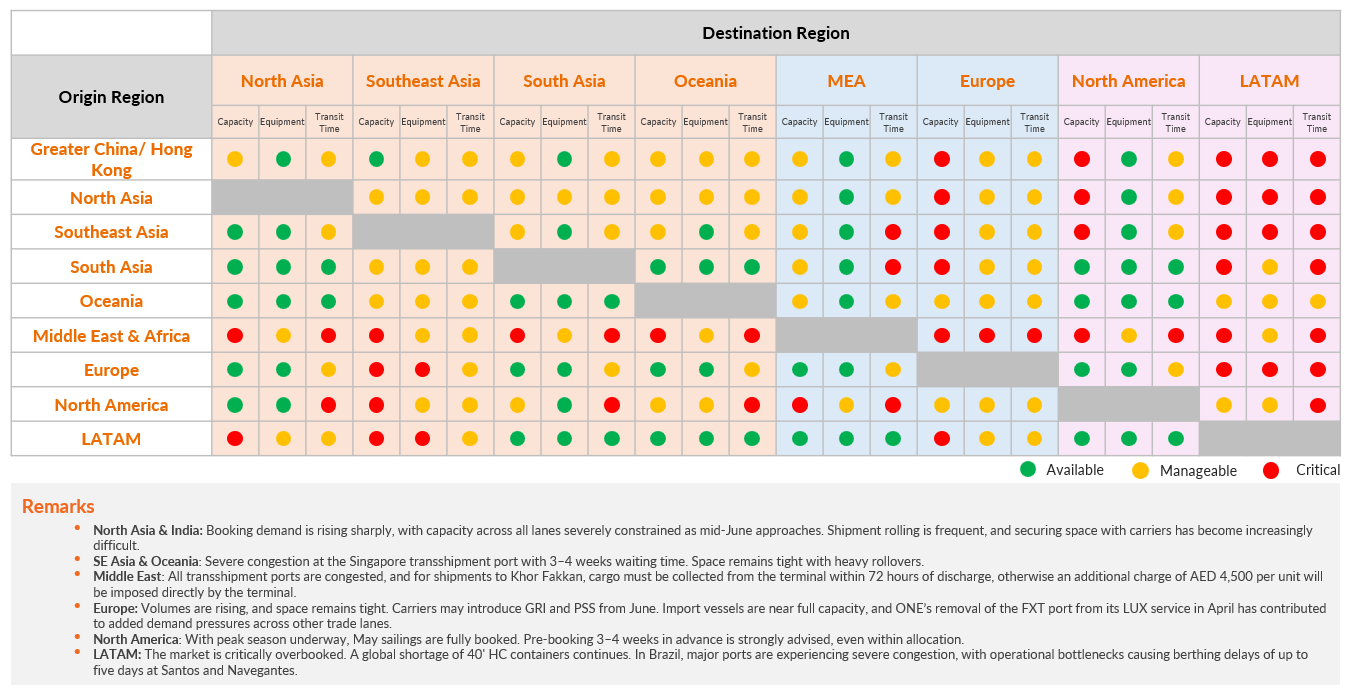
### Ocean Freight Snapshot (June 2026)
## Air Freight Updates
### **Air Rates Easing From Peak but Remaining Well Above Pre-Conflict Levels**
The air freight market entered June in a materially different position than it was in April. Jet fuel prices have fallen approximately 25% from their March peak, as refineries outside the Gulf have increased production and demand has eased with cost-driven flight cancellations reducing consumption. Some carriers have begun reducing Fuel Surcharges in response. Freightos Air Index data for the week of 26 May showed China-Europe prices easing to under USD 5.00 per kilogram, while South Asia-Europe rates, still elevated at above USD 4.50 per kilogram, were moving below the USD 5.15 per kilogram peak reached in April.
The rate trajectory is now past the crisis peak, but the structural conditions that drove the spike have not been resolved. Qatar Airways Cargo through Doha remains suspended, Gulf carrier capacity is operating well below normal, and war-risk premiums and airspace uncertainty across the broader region are creating a higher baseline for operating costs on affected lanes. Air cargo rates are, for the most part, past their April-May highs, but they remain substantially elevated relative to pre-conflict 2025 levels. For budgeting purposes, the pre-conflict rate environment should not be used as a planning assumption for the remainder of 2026.
**What this means for Australia and New Zealand customers**
- The easing of fuel-related surcharges represents a genuine cost improvement for air programmes compared to April-May highs. Confirm current FSC schedules before locking in air freight quotes — rates are moving more frequently than usual and may differ significantly from indications provided even two weeks ago.
- For Asia-Europe air moves with Gulf hub dependencies, the partial recovery of Emirates and Etihad capacity has improved service frequency but has not restored schedule reliability to pre-conflict standards. Qatar Airways Cargo through Doha remains suspended. Continue to treat Gulf-hub-dependent routings as higher risk and confirm alternatives.
- C.H. Robinson's May update noted air conditions as corridor-dependent, with incremental belly capacity growth emerging unevenly by gateway pair. For Asia-Oceania direct lanes, conditions are more stable than Gulf-adjacent trades, but the global capacity tightening has an indirect effect on equipment positioning and availability.
### **Early Peak Season Demand Building in Air: Book Ahead for July-August**
Freightos reported on 26 May that demand is rebounding and an early start to the ocean peak season is underway. Air freight typically follows ocean markets with a three to four week lag, and the combination of stronger demand, reduced Gulf hub capacity, and lean inventory positions across several consumer categories is expected to produce tighter air conditions through July and August. For time-sensitive product launches, promotional inventory, or exception recovery cargo, securing capacity and routing before the peak period tightens is strongly recommended.
**What to do now:** For any known air freight requirements in July or August, book now. Even for flexible shipments, getting rate indications and capacity pre-approvals locked in before the peak demand window builds provides meaningful cost and scheduling protection. Speak with your KLN Oceania air freight team about pre-booking options.
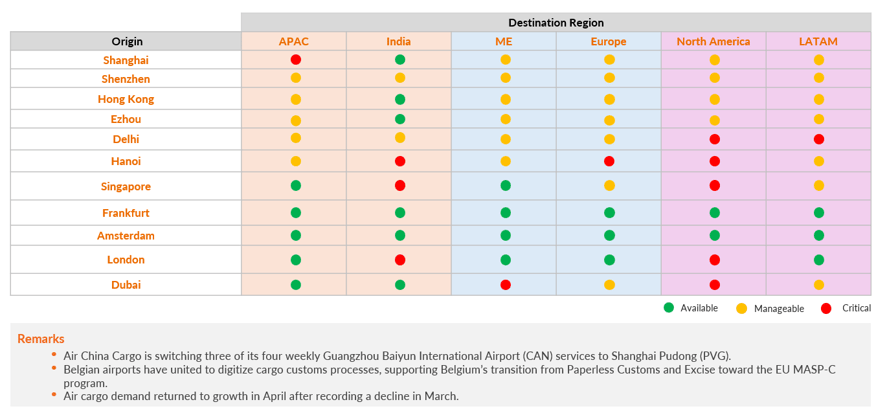
### Air Freight Snapshot (June 2026)

## Customs, Inland Transport, Terminal and Regulation Updates
##### 
### NZ: **Port of Auckland | VBS & Access Fee Increases – 1 July 2026 & 1 January 2027**
Please note upcoming changes to Vehicle Booking System (VBS) and port access charges at Port of Auckland, affecting movements through Fergusson Container Terminal and Multi-Cargo operations.
**Two confirmed increase dates**
- **1 July 2026** VBS and port access fee increases come into effect as previously advised. These apply to full container movements across both Fergusson Container Terminal and Multi-Cargo.
- **1 January 2027** A further round of fee adjustments will apply from 1 January 2027. Notably, the January 2027 fees for Fergusson Container Terminal have been revised downward from the figures originally indicated — a positive update reflecting Port of Auckland's latest confirmed schedule.
**What this means for your business**
These charges are levied by Port of Auckland to transporters and will be on-charged accordingly. We recommend factoring both increase dates into your forward planning, quoting, and procurement processes as soon as possible.
To help manage cost exposure, we also suggest considering:
- Off-peak slot scheduling where possible
- Alternative routing via Port of Tauranga where operationally suitable
- Dynamic FCL Hubbing as a cost management option
Your KLN Oceania representative can walk you through how these changes apply to your specific cargo profile and help you plan accordingly. Please don't hesitate to reach out.
### NZ: 50MAX Permits Removed. What Changes for Road Freight
On 20 May 2026, the New Zealand Government permanently removed permit requirements for 50MAX vehicles and for the repositioning of unladen rental high-productivity motor vehicles (HPMVs) back to depots. These changes are in effect now.
The permit requirement for 50MAX operations was a compliance overhead with no road safety justification in standard operating conditions. Its removal reduces administrative cost and friction for operators running these vehicles on regular freight programmes, a practical efficiency gain that is particularly relevant for inter-regional distribution in the North and South Islands.
Temporary measures remain available under the National Fuel Response Plan. At Phase 2 activation, over-dimension vehicles gain access to selected motorways and toll roads currently inaccessible to them. At Phase 4, permitted HPMV weight limits increase by approximately 4%, and 50MAX vehicles may operate at up to 55 tonnes, a 10% increase.
Transporting New Zealand has publicly called for greater urgency in the broader reform programme, noting the May changes are a step but not the full scope of what the fuel security environment requires.
### NZ: Congestion Charging Proposal. A Cost the Freight Sector Is Contesting
A Ministry of Transport proposal to introduce time-of-use congestion charging in New Zealand includes a provision charging heavy vehicles at four times the rate of passenger cars. Under the framework as proposed, if a standard car pays NZD 4.50 per movement through a charging zone, a truck would pay NZD 18.00. The charge applies per entry, exit or transit during charging hours, subject to a daily cap.
Transporting New Zealand submitted on 1 May that this ratio is out of step with every comparable international scheme it could identify. London, Stockholm and Gothenburg apply flat rates. Singapore and New York City, which do differentiate, set their ratios materially lower than four times.
The industry body is advocating for a cap at no more than twice the car rate and argues that the four-times multiplier functions as a supply chain cost tax rather than a congestion management tool, since freight vehicles have limited flexibility to shift delivery times.
The consultation is ongoing. No implementation timeline has been confirmed. For businesses with significant last-mile freight volumes moving through central Auckland, including retailers, FMCG distributors and manufacturers serving the Auckland region, the outcome of this consultation will directly affect operating cost structures. The submission window is closed, but the policy outcome is not yet determined.
### NZ: What the KiwiRail Investment Means for Your Supply Chain Planning
The NZD 1.075 billion KiwiRail allocation for 2027–2030 and the NZD 65 million for Marsden Point rail link engineering design are more than infrastructure budget lines. They are planning inputs for logistics managers thinking beyond 2026.
The Marsden Point rail link is designed to connect Northport, one of New Zealand’s only major ports without rail access, to the national freight network. When complete, it will allow cargo to move from Northport into Auckland and the wider North Island by rail, reducing dependence on road transport for what is currently New Zealand’s fastest-growing port by container volume.
For businesses importing or exporting through Northport, or for those whose supply chains currently require road-only movement from the North Auckland port precinct, the rail connection materially expands future routing and cost options.
The broader KiwiRail capital injection sustains maintenance, renewal and operational continuity on the national network for the 2027–2030 period. This commitment underpins multimodal planning confidence for anyone operating on rail-served corridors across the Waikato, Manawatu-Whanganui and Canterbury regions.
---
*Contact our KLN Oceania account manager for freight planning support, cargo insurance review, or customs brokerage advice specific to your programmes.*
[](https://info.oceania.kln.com/hs/cta/wi/redirect?encryptedPayload=AVxigLISrh46KKqlYroa%2F1sb27RDjC3PhNr0gu5%2FpmUVUHjqx5yrY0r2tfEWUtzHALD98H1ysUD%2FHjRgZRHikmdYF40KQ4telm21pdKLlR%2B2ym9amKM6r7fW8L%2BjOlEYVtzTVIRolH3ywjSEl6I4kvQ437yfCmuhOu9eYJWDKSWYk%2BeiBBqQiWILLBabLiB66F0AKJ%2FxkKHBoMpJGlWl&webInteractiveContentId=148519118772&portalId=40234550)
### Why Partner with KLN
Selecting KLN Oceania as your trusted partner isn't just a choice—it's a strategic move towards ensuring your success. Our commitment to excellence is not just a promise; it's a guarantee. With a global network that's both vast and meticulously managed, we stand head and shoulders above the competition. This means you benefit directly from unparalleled service quality, ensuring your supply chain needs are met with precision, efficiency, and minimal hassle.
Are you ready to elevate your logistics game and experience seamless support tailored to your unique needs? Let's discuss how we can bring unparalleled value to your business.
[](https://info.oceania.kln.com/hs/cta/wi/redirect?encryptedPayload=AVxigLISrh46KKqlYroa%2F1sb27RDjC3PhNr0gu5%2FpmUVUHjqx5yrY0r2tfEWUtzHALD98H1ysUD%2FHjRgZRHikmdYF40KQ4telm21pdKLlR%2B2ym9amKM6r7fW8L%2BjOlEYVtzTVIRolH3ywjSEl6I4kvQ437yfCmuhOu9eYJWDKSWYk%2BeiBBqQiWILLBabLiB66F0AKJ%2FxkKHBoMpJGlWl&webInteractiveContentId=148519118772&portalId=40234550)

## Related articles
[View All](https://info.oceania.kln.com/konnect)
[Konnect](https://info.oceania.kln.com/konnect/tag/konnect) [KONNECT - OCTOBER 2026](https://info.oceania.kln.com/konnect/konnect-october-2026)
02 Oct 2026
[Konnect](https://info.oceania.kln.com/konnect/tag/konnect) [KONNECT - SEPTEMBER 2026](https://info.oceania.kln.com/konnect/konnect-september-2026)
04 Sep 2026
[Konnect](https://info.oceania.kln.com/konnect/tag/konnect) [KONNECT - AUGUST 2026](https://info.oceania.kln.com/konnect/konnect-august-2026)
31 Jul 2026
[Konnect](https://info.oceania.kln.com/konnect/tag/konnect) [KONNECT - JULY 2026](https://info.oceania.kln.com/konnect/konnect-july-2026)
08 Jul 2026
[Konnect](https://info.oceania.kln.com/konnect/tag/konnect) [KONNECT - MAY 2026](https://info.oceania.kln.com/konnect/konnect-may-2026)
05 May 2026
[Konnect](https://info.oceania.kln.com/konnect/tag/konnect) [KONNECT - APRIL 2026](https://info.oceania.kln.com/konnect/konnect-april-2026)
30 Mar 2026
[Konnect](https://info.oceania.kln.com/konnect/tag/konnect) [KONNECT - MARCH 2026](https://info.oceania.kln.com/konnect/konnect-march-2026)
27 Feb 2026
[Konnect](https://info.oceania.kln.com/konnect/tag/konnect) [KONNECT - DECEMBER 2025](https://info.oceania.kln.com/konnect/konnect-december-2025)
05 Dec 2025
### Notices
### Company
### Locations
Connect with KLN Oceania
[](https://www.linkedin.com/company/29366171/)
[](https://www.kln.com/)
© 2026 KLN FREIGHT (OCEANIA) LIMITED. ALL RIGHTS RESERVED.
- [Trading terms](https://oceania.kln.com/legal/trading-terms/)
- [Terms & conditions of use](https://oceania.kln.com/legal/terms-conditions-of-use/)
- [Privacy policy](https://oceania.kln.com/legal/privacy-policy/)
- [Disclaimer](https://oceania.kln.com/legal/disclaimer/)
```json
{
"@context" : "https://schema.org",
"@type" : "BlogPosting",
"author" : {
"@type" : "Person",
"name" : "KLN Oceania",
"url" : "https://info.oceania.kln.com/konnect/author/kln-oceania"
},
"dateModified" : "2026-06-05T02:15:04.572Z",
"datePublished" : "2026-06-05T01:38:46.000Z",
"headline" : "KONNECT - JUNE 2026",
"image" : [ "https://info.oceania.kln.com/hubfs/banner%20konnect%202026%202.png" ],
"mainEntityOfPage" : {
"@id" : "https://info.oceania.kln.com/konnect/konnect-june-2026",
"@type" : "WebPage"
},
"publisher" : {
"@type" : "Organization",
"logo" : {
"@type" : "ImageObject",
"url" : "https://info.oceania.kln.com/hubfs/KLN%20Logo_colour.jpg"
},
"name" : "KLN FREIGHT (OCEANIA) PTY. LTD."
}
}
```