
-

-

-

-

-
Copy to clipboardLink Copied


Executive Summary
July produced a month unlike any other in 2026: a genuine peace agreement that briefly reopened the Strait of Hormuz, a second escalation cycle that effectively re-closed it within weeks, Section 301 tariffs landing the moment Section 122 expired, the steepest month-on-month FCL rate increase of the year on the Asia-Oceania trade, and a policy divergence between Australia and New Zealand that sharpened further. None of these threads are resolved entering August. Several have intensified.
The Strait of Hormuz has now experienced two distinct closure cycles within a single month. The MOU signed at Versailles on 17 June briefly produced real results — oil fell below USD 80 per barrel, 55 merchant ships crossed on 18 June, and CENTCOM confirmed traffic was moving. By 7 July, attacks on commercial vessels had resumed. By 14 July, the US had reinstated its naval blockade of Iranian ports. On 30 July, PortWatch recorded just 10 transits against a pre-crisis baseline of 88 per day, following US strikes on Iran on the night of 29-30 July. For the first time this year, a second chokepoint has joined the disruption: Houthi forces declared a blockade of Saudi Arabian ports from 20 July, and Bab el-Mandeb crossings have fallen by roughly half against the Q2 average. Both major Middle East maritime chokepoints are now contested simultaneously, and war-risk insurance premiums for transits of either strait have risen to many multiples of pre-conflict levels. Cape of Good Hope routing remains the operational standard for all major carriers. The brief partial reopening in late June and early July was not sufficient to change vessel deployment decisions for networks that had already committed to longer-route schedules.
The US tariff framework shifted permanently on 24 July. Section 122 expired by statute, and Section 301 forced-labour tariffs took effect simultaneously across 60 economies. Australia and New Zealand are both confirmed in scope at a flat 12.5% rate — a mechanism with no statutory expiry date and no automatic review process. Both governments have publicly rejected the forced-labour basis for their inclusion and are actively lobbying the USTR, but neither has secured a change. The position is more exposed than it appears: Section 122's expiry lowers the average tariff burden for most other US trading partners, making Oceania comparatively more disadvantaged, not less. For exporters of beef, gold, copper, dairy, and other affected categories, and for any business selling DDP into the US market, landed-cost models and contract pricing built under the prior regime require immediate revision.
Ocean freight costs on the Asia-Oceania trade reached their 2026 cycle highs in early-to-mid July, with China-to-Australia FCL rates rising approximately 49% month-on-month on the back of two rounds of GRIs totalling USD 500 per TEU and peak season surcharges of up to USD 500 per TEU. Rates have since begun to ease, but port congestion globally reached its highest level in four years — an estimated 3.4 million TEU stranded at anchor worldwide following severe weather events across major Chinese ports — keeping the market structurally unsettled despite the directional softening. New services from Maersk (Qilin) and COSCO (A3X) have entered the China-Australia trade with meaningfully faster transit options, but new capacity takes time to translate into rate relief. Domestically, July opened with the fuel excise cut expired, DAFF biosecurity fees up 3.8%, Fremantle port access charges up 4.6%, and Port of Auckland VBS fees up 28%. The RBA held the cash rate at 4.35% at its June meeting and next convenes on 11 August, with most major banks forecasting a hold. The RBNZ delivered its first rate increase since 2023 on 8 July, lifting the OCR to 2.50%, and markets currently price roughly a 60% probability of a further hike at the 2 September meeting. For importers and exporters across Oceania, August begins from a higher cost base than any prior month this year, with peak season demand building, equipment tight at several Australian and New Zealand terminals, and the freight budget assumptions that underpinned 2026 planning now substantially out of date.
Business Tip
Lock Q4 bookings now — August and September are the peak months for Christmas-season inventory
Booking utilisation on Asia-Oceania services remains elevated, blank sailings continue at over 10%, and new capacity entering the trade takes time to translate into available space. Carriers are managing allocations actively, and containers are already rolling on some services. If your Q4 import programme is not booked, the window is narrowing. Speak with your KLN Oceania account manager about carrier options, space availability, and cut-off planning before peak season competition tightens it further.

Spotlight
Peak Season Capacity is Tight: Stay Ahead With Planned Airfreight
For Oceania importers and exporters relying on time-sensitive air cargo, this is the moment to act, not react. The businesses that come through peak season unscathed are the ones with capacity secured before the crunch hits — not after.
This is where KLN's air freight network is built differently. We hold established contracts with major carriers — including Air New Zealand, Qantas, Singapore Airlines, and China Airlines — giving us consistent access to space even as general market capacity tightens. Beyond that, KLN operates our group's own dedicated cargo airline, SF Airlines, with a fleet of 79 aircraft, adding a layer of capacity control that most forwarders simply don't have.


Market Trend
July 2026 produced a sequence of events that no single earlier month had managed: a genuine peace deal in the Middle East that briefly reopened the Strait of Hormuz, followed by a second escalation cycle that effectively re-closed it. Section 122 tariffs expired on schedule and were seamlessly replaced by Section 301 forced-labor tariffs at a lower and flatter rate than most had forecast. The RBA held at 4.35% while the RBNZ delivered its first rate increase in over three years. And across the freight market, the sharpest FCL rate surge of 2026 arrived on the Asia-Oceania trade precisely as carriers introduced new capacity. These threads are all active heading into August.
Middle East: Peace Deal in June, Second Escalation in July
The month's single most significant development arrived not in July but in June: on 17 June 2026, US President Donald Trump and Iranian President Masoud Pezeshkian signed a Memorandum of Understanding ending the war and providing for the full reopening of the Strait of Hormuz without tolls for at least 60 days. Oil prices fell sharply — Brent dropped below USD 80 per barrel on the announcement, its lowest since before the conflict began. Goldman Sachs revised its Brent forecast down to USD 80 per barrel for Q4 2026.
The reopening was real but far from normal. According to PortWatch data, only 513 ships transited the strait in the first 18 days after reopening between 18 June and 5 July, averaging 28 vessels per day against the pre-war baseline of approximately 100 per day. The backlog of more than 800 stranded vessels — including many crude tankers that had been waiting for months at anchorage in the Gulf of Oman — was not something that could be cleared in days. Industry executives and shipping experts warned at the time that it would take weeks, and in some cases months, for normal supply to be restored.
Then, on 7 July, a second escalation cycle began. Three vessels were struck near Oman, and the US revoked Iran's oil-sale sanctions waiver. Strikes continued in the days that followed. On 12 July, Iran's IRGC struck two AIS-dark supertankers and a Cyprus-flagged container ship; on 13 July, the UAE's state oil company ADNOC confirmed two of its own tankers were struck by projectiles in Omani territorial waters. As of 30 July, PortWatch recorded just 10 transits — against a pre-crisis baseline of 88 per day — and the situation had deteriorated further after the US struck Iran directly on the night of 29-30 July. The 60-day toll-free window from the MoU remains technically in force, but practical throughput through the strait is at the same critically low levels seen in April and May.
What this means entering August
- Cape of Good Hope routing remains the operational standard for all major container carriers and tanker operators. The brief partial reopening in late June and early July was not sufficient to change vessel deployment decisions for the networks that had already committed to longer-route schedules.
- Oil prices have rebounded from their post-MoU lows. Brent crude was at approximately USD 87 to 89 per barrel in late July, reflecting the second escalation. This feeds directly into bunker fuel costs and carrier surcharge schedules. Fuel surcharges that were beginning to ease in early July have stabilised or reversed.
- For Oceania supply chains, the indirect consequences of an extended closure continue: elevated fuel surcharges, constrained transhipment hub capacity, and vessel deployment decisions on Oceania services shaped by the global capacity picture rather than the Oceania market alone.
- Any genuine sustained reopening of the strait would produce a sharp downward adjustment in oil prices and fuel surcharges. Monitor carrier advisories closely. Where fuel surcharges have validity windows, confirm these before finalising freight budgets for August.
Section 301 Takes Effect: Australia and New Zealand Confirmed at 12.5%
On 24 July, the USTR's Section 301 forced labour action took effect on 60 economies, the same moment the temporary Section 122 global tariff surcharge expired by statute. Australia and New Zealand are both confirmed within scope, at the flat 12.5% rate applied to most covered economies. Unlike Section 122, this mechanism has no statutory expiry date. Goods loaded and in transit before 24 July may have qualified for a transition allowance if entered by 28 July, but that window is now closed for practical planning purposes.
Both governments have publicly rejected the forced labour basis for their inclusion and are lobbying the USTR for removal. Neither has secured a change so far. New Zealand's goods exports to the US, its second-largest market, are directly affected. So are Australian exporters of beef, gold, copper and other goods. And the position is worse than it looks: the expiry of Section 122 lowers the average tariff rate for most other US import sources, which makes Oceania comparatively more exposed, not less.
What this means entering August
- Review the country-of-origin and HS classification of every US-bound product line now; the 12.5% rate applies at the product level and misclassification carries direct cost exposure.
- Do not assume the transition allowance still applies to cargo not yet loaded. Treat 24 July as the operative date for all new bookings.
- Monitor government lobbying efforts, but do not build pricing or contracts on the assumption of a near-term rate change. There is no confirmed timeline for review.
Hormuz and Bab el-Mandeb: Two Chokepoints Under Pressure at Once
The Hormuz MOU signed on 17 June did not hold. Iran resumed attacks on commercial vessels from 6 July, targeting at least nine ships through the month, and the US reinstated its naval blockade of Iranian ports on 14 July. Traceable crossings via the Oman-protected southern route have effectively halted. The US Navy has redirected vessels attempting to run the blockade, and in some cases disabled or boarded them. Iran and Oman opened talks in late July to restore passage, but no agreement or timeline has been confirmed.
A second chokepoint has now joined the disruption. Houthi forces declared a blockade of Saudi Arabian ports from 20 July, and Bab el-Mandeb Strait crossings have fallen by roughly half compared with the Q2 average. The largest tankers are avoiding the route almost entirely. War-risk insurance premiums for transits of both straits have risen to many multiples of pre-conflict levels and remain highly volatile. For the first time this year, both major Middle East maritime chokepoints are contested at once.
What this means entering August
- Do not assume routing normalises in the near term. Confirm with your carrier which route is being used for any Middle East-transiting cargo and build in contingency time.
- Review cargo insurance cover against the current risk map, not the one from earlier in the year. Both straits now carry elevated war-risk premiums.
- Factor continued schedule volatility into ETA commitments on any lane that transits the Gulf or Red Sea, even indirectly.
Developments in Oceania
Australia’s Economic Outlook
Australia's June quarter CPI eased to 3.8% annually, down from 4.0% in May. Quarterly inflation slowed sharply too, down to 0.6% from 1.4% in the March quarter. Housing remained the largest contributor to annual inflation at 6.8%, while transport inflation moderated as automotive fuel prices fell for three consecutive months through June. Underlying inflation held firmer, however: the trimmed mean sat at 3.6% annually, which keeps the RBA cautious even as headline numbers cool.
The labour market showed some softening too, with unemployment rising 0.1 percentage points to 4.4% in June. The cash rate has held at 4.35% since June, and the RBA next meets on 11 August, its first chance to respond to the full June inflation and labour data. CBA, NAB and ANZ all expect a hold through the rest of 2026. Westpac disagrees, still calling for one further hike, with August seen as the most likely month if it comes. The Australian dollar has traded softer through late July, easing from the high 0.70s to around 0.696 against the US dollar as at 29 July.
New Zealand’s Economic Outlook
The RBNZ raised the OCR by 25 basis points, from 2.25% to 2.50%, on 8 July. It was the Bank's first increase since May 2023, ending a hold that had been in place since November 2025. The concern was straightforward: leaving the rate unchanged risked further easing in financial conditions, through expectations of a lower year-end OCR and a softer exchange rate, which would work against getting inflation back to target. Bank economists broadly expect the tightening cycle to continue. Most are projecting the OCR reaching approximately 3.0% by year end, via two further quarter-point increases, and markets currently price roughly a 60% probability of another hike at the 2 September meeting.
New Zealand's June trade figures show exactly why exporters and importers are under pressure at the same time. Goods exports rose 25% year-on-year to a record monthly value, driven by strong dairy demand (milk powder, butter and cheese exports rose 16%) and a 43% jump in exports to the US, consistent with frontloading ahead of the Section 301 deadline. Imports rose 28% over the same period, however, as petroleum import costs doubled. The result: the trade surplus narrowed to almost nothing. The exporting side of the New Zealand economy is performing strongly. The cost side is absorbing significant new pressure at the same time.
Trade & Industry Highlights
The shared theme across both economies is a widening gap: what exporters are earning versus what importers and consumers are paying. Australia's cooling inflation and softening labour market argue for a steady policy hand. New Zealand has moved decisively in the other direction, on the view that inflation risk has not passed. For Oceania businesses with US-bound programmes, the Section 301 tariff adds a further cost layer at exactly the moment shipping costs remain elevated by historical standards, even as they ease from the cycle highs of early July. Update your landed-cost models now, rather than waiting for invoices to arrive. It will put you in a better position to manage margin through the September quarter.
Ocean Freight Updates
Rates Ease From Cycle Highs, But Congestion Keeps the Market Unsettled
Ocean rates reached their 2026 cycle highs in early-to-mid July, driven by frontloading ahead of both the Section 122 tariff expiry and the anticipated Section 301 action. Rates have since begun to ease. In the week to 29 July, the Freightos Baltic Index recorded Asia to US West Coast (FBX01) down 12% and Asia to US East Coast (FBX03) down 1%, while Asia to North Europe (FBX11) fell 3% and Asia to Mediterranean (FBX13) fell 2% over the same week. The Drewry World Container Index fell 4% in the week to 23 July. Two things are driving the pullback: additional vessel capacity deployed to meet the earlier surge, and a genuine cooling in demand now that the frontloaded rush has passed.
Port congestion has not eased with the rates
A significant weather event shut down several major Chinese ports in July, causing serious vessel bunching at Shanghai and Ningbo and multi-day waits at Qingdao, with knock-on delays in Taiwan, South Korea and the Philippines. Combined with ongoing Middle East disruption, this pushed global port congestion to its highest level in four years, with an estimated 3.4 million TEU of capacity effectively stranded at anchor worldwide. China-to-Australia capacity remains tight as a result, with surcharges and booking delays continuing to affect the trade lane.
Peak season arrives against an unusually volatile backdrop
The traditional ocean freight peak season, typically running from August into November, is beginning against an unusual backdrop: easing base rates alongside elevated structural risk. On the Asia-to-Australia lane specifically, ANL, MSC and OOCL have all announced peak season surcharges on South East Asia and North East Asia services, effective from early July. Industry advice is for shippers to book at least ten days ahead, as capacity on the Asia-Oceania trade lane tightens through July and August. The practical read for Oceania importers: headline rates are directionally softer than a month ago, but capacity on the lanes that matter most to this market is tightening, not easing.
What this means entering August
- Do not assume the July rate declines are the start of a sustained downtrend. Port congestion and Middle East disruption remain live risks that can reverse the trend quickly.
- Confirm current transit times, not historical schedules, when making customer delivery commitments. Vessel bunching in China is adding real delay on top of any pricing movement.
- Review carrier and routing options for any cargo that would ordinarily transit near the Gulf or Red Sea, even on services that do not call directly at affected ports.
- Speak with your KLN Oceania account manager to confirm booking and equipment availability ahead of the August-November peak.
FCL Rates Surged 49% Into Australia in July — August Holds From That Base
July produced the sharpest month-on-month FCL rate movement on the China-Australia trade in 2026. Spot rates from major Chinese origins into Sydney, Melbourne, and Brisbane rose approximately 49% compared to June, driven by two rounds of General Rate Increases totalling USD 500 per TEU effective 1 July, Peak Season Surcharges of up to USD 500 per TEU, and carrier blank sailings running at an 11.2% rate. Indicative July rates: 20-foot containers at USD 2,205 to 2,695, and 40-foot containers at USD 4,365 to 5,335. North Asian origins saw the sharpest increases; Southeast Asian origins moved up more moderately but remain at elevated levels relative to Q1 2026.
The KLN Oceania August 2026 Outlook, published on 22 July, describes August as beginning from this elevated base, with further surcharge risk and ongoing blank sailing discipline. ANL has proposed an Emergency Space Surcharge of USD 350 per TEU, with other carriers signalled to follow if it is applied successfully. As of August entry, biosecurity cost recovery charges on import declarations increased from 1 July, Fremantle Port access charges rose 4.6% from 1 July, and revised terminal service fees at Sydney air freight facilities took effect 24 July — all components that layer onto the total cost picture beyond ocean base rates.
New services entering the market: more options, not yet rate relief
Three significant new services have launched or are in launch phase on the China-Australia trade. Maersk's Qilin service commenced operations on approximately 24 July 2026, operating a streamlined Shanghai-Sydney-Melbourne rotation with transit times of approximately 14 days to Sydney — four days faster than previous standard schedules. COSCO's A3X service launched from Qingdao on 27 July, covering Qingdao, Shanghai, and Shekou before calling Melbourne and Sydney. ZIM has also entered the trade. These services represent a genuine increase in available capacity and routing choice, including meaningfully improved transit options for time-sensitive importers.
The honest assessment — reflected in both the KLN Oceania August Outlook and independent market analysis — is that new capacity takes time to absorb existing demand and reduce rate pressure. August will remain firm. Equipment remains tight, particularly 20-foot containers across New Zealand ports and at several Australian terminals. The new services do provide more booking options and stronger competition for allocations, which is a positive development for shippers who engage early.
What to do now
- Request all-in quotes — not base rate quotes. Surcharges including PSS, Emergency Space Surcharges, and biosecurity charges are separate line items and have moved significantly. A quote without these components understates your actual landed cost.
- Lock Q4 bookings now. August and September are the peak booking months for Christmas-season inventory. Waiting until cargo is ready is a planning error in this market. For retailers and consumer goods importers, bookings for October-December arrival need to be confirmed through August.
- Ask specifically about the Maersk Qilin and COSCO A3X services. Where transit time is a constraint, these new fast rotations provide a genuinely improved option against the standard services currently operating on the trade.
- Update your landed cost models. The August 1 domestic fuel excise restoration, July GRIs, and ongoing surcharges mean that cost assumptions from H1 2026 may understate true landed costs by a meaningful margin. Re-run these calculations before Q4 pricing and procurement commitments go out.
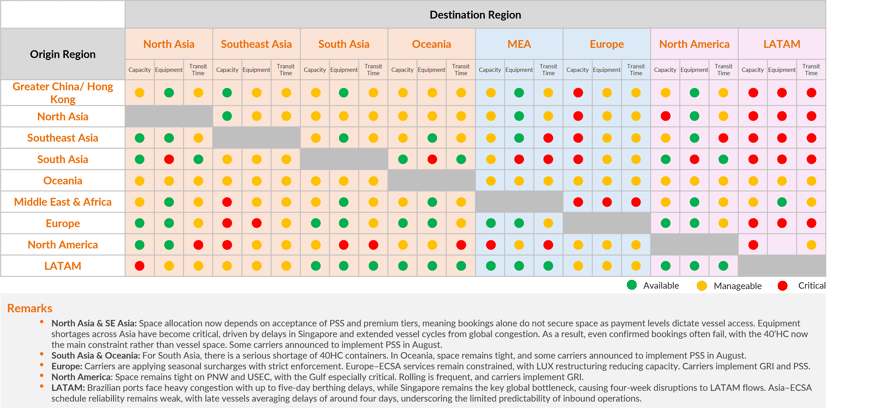
Ocean Freight Snapshot (August 2026)
Air Freight Updates

Gulf Capacity Tightens Further as Conflict Escalates
Air freight capacity from Middle Eastern and South Asian origins fell a further 3–4% week-on-week in late July, as the Hormuz and Bab el-Mandeb disruptions intensified. Gulf carriers are among the hardest hit globally, and Cathay Pacific postponed its planned resumption of Riyadh freighter services as a direct result. Rates on the most exposed lanes remain roughly double pre-war levels.
The core Asia-Pacific lanes serving Oceania tell a calmer story. Spot rates to the US were comparatively stable through late July, easing slightly week-on-week but still running well above year-ago levels. Rates to Europe followed a similar pattern, with the year-on-year premium narrowing slightly on the China-Europe corridor specifically. The gap between the most conflict-exposed lanes and the broader Asia-Pacific market has widened: capacity constraints are now concentrated in and around the Gulf, rather than spread evenly across the region.
Separately, Qantas Freight's import operations through Sydney remain affected by delays linked to a cloud-based systems cutover earlier in the year. Industry bodies including the Freight & Trade Alliance and the Australian Peak Shippers Association report that longer dwell times and limited status visibility on landed cargo remain a live issue for businesses moving freight through Qantas terminals. Build additional buffer into time-sensitive import planning through Qantas Sydney until full operational recovery is confirmed.
What this means entering August
- For time-sensitive cargo routed anywhere near Gulf hubs, confirm current carrier routings rather than assuming pre-conflict service patterns still apply.
- Core Asia-Pacific-to-Oceania lanes are comparatively more stable, but book preferred uplift dates ahead of the August-November peak rather than assuming spare capacity will be available on short notice.
- Continue to monitor Emergency Fuel Surcharge schedules, which are moving in both directions depending on carrier and lane.
Qantas Freight Import Delays: Sydney Operations Still Recovering
Import freight delays at Qantas Freight terminals, particularly in Sydney, continued to be a live issue through the start of July. As of 3 July, KLN Oceania's advisory noted extended dwell times on import shipments, limited visibility on freight status once cargo had landed, and difficulty obtaining timely operational updates from terminal staff. The Freight and Trade Alliance and Australian Peak Shippers Association raised these concerns directly with Qantas Freight executive management and participated in broadcast media interviews to highlight the operational impact.
What to do now: If you have import freight arriving into Sydney on Qantas services, allow additional buffer time for release and delivery until Qantas Freight confirms full operational recovery. Contact your KLN Oceania representative for status on specific shipments. For time-sensitive cargo due through Sydney, consider whether alternative carrier routings into other Australian gateways reduce exposure to the Qantas terminal backlog.
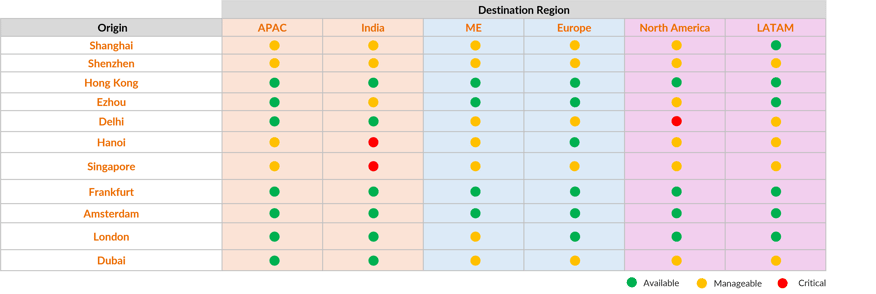
Air Freight Snapshot (August 2026)

Customs, Inland Transport, Terminal and Regulation Updates
AU — New Services and Routing Options on the China-Australia Trade
The entry of Maersk's Qilin service (commencing approximately 24 July) and COSCO's A3X service (commencing from Qingdao on 27 July) onto the China-Australia trade provides meaningful new routing options for importers, including faster transit times. The Qilin service offers a Shanghai-Sydney rotation at approximately 14 days to Sydney and 17 days to Melbourne — four days faster than standard services. These services operate in addition to existing carriers and provide new options for booking flexibility, particularly for importers managing tight delivery windows or seeking to reduce rollover risk on heavily subscribed regular sailings. Both services will take time to reach full operational stability as rotations bed in.
What to do now: Ask your KLN Oceania account manager specifically about availability on the Qilin and A3X services for upcoming shipments. For importers where transit time is a constraint on delivery promises, the faster Qilin rotation is worth evaluating as a premium routing option. Confirm cut-offs and inland connection schedules on new services before committing delivery dates to customers or buyers.
AU/NZ — Carrier Service Updates: ONE Alliance Changes and Network Adjustments
Ocean Network Express will no longer participate in several OCEAN Alliance transpacific loops following the conclusion of slot agreements with CMA CGM, OOCL, and Evergreen on 6 July 2026. The final sailing on the affected CP1 loop was the CMA CGM Titan. The affected services include CP1, CP2, CP3, and CP4. While these are primarily transpacific services, network realignments of this scale can have downstream effects on vessel deployment decisions, equipment positioning, and the availability of space on connected services into the Pacific and Oceania regions. Customers using ONE or CMA CGM for US-bound cargo should review their routing arrangements and confirm available capacity for upcoming sailings.
What to do now: Speak with your KLN Oceania account manager to confirm current vessel availability and routing options for any shipments previously booked on or connected to the affected OCEAN Alliance transpacific services. Where alternative carriers or routing options are needed, book early — peak season competition for space means alternatives are not always immediately available.
NZ: Port of Auckland | VBS Access Fees Continue to Climb
Port of Auckland's Vehicle Booking System access fees, already increased from 1 July, are scheduled to rise further by January 2027, with container cartage costs adjusting to recover the increases. Port of Tauranga has not announced comparable increases, and some transport operators are assessing whether shifting volume to Tauranga is operationally feasible for their networks. Businesses using Fergusson Container Terminal should continue to model the fee trajectory rather than treating the July increase as a one-off adjustment.
AU: Fuel Excise and Domestic Freight Costs Settling at the New Baseline
Following the fuel excise reduction's expiry on 30 June, domestic road freight costs in Australia have now settled at the higher post-excise baseline through July. Businesses that had not yet updated cost-per-kilometre models should treat July invoices as the new reference point going into August, rather than a temporary spike.
AU: DAFF Biosecurity Charges | Next Review Point is 1 November
The 3.8% indexation increase to most biosecurity and imported food regulatory charges that took effect 1 July remains current. The Department of Agriculture, Fisheries and Forestry has flagged a broader revision to cargo diagnostic charges, introducing cost recovery for services not previously charged or only partially recovered, from 1 November 2026. Importers of plant products, live animals and goods requiring laboratory testing should begin reviewing exposure ahead of that date rather than waiting for the detailed schedule.
AUS: Port Hedland | Industrial Action at Australia's Largest Iron Ore Export Terminal
Combined Ports Unions gave notice of protected industrial action at BHP's Port Hedland Bulk Export Terminal, including an eight-hour work stoppage on 16 July, after more than six months of enterprise agreement negotiations failed to reach resolution. A final bargaining session on 14 July also closed without agreement. Port Hedland is Australia's largest iron ore export terminal and one of the highest-volume bulk export ports globally. This disruption sits outside container freight, but it signals that industrial relations risk across Australian ports remains unresolved heading into August. Businesses with exposure to WA bulk export capacity, or downstream supply chains that depend on it, should monitor for further protected action notices.
Contact our KLN Oceania team for freight planning support, cargo insurance review, or customs brokerage advice specific to your programmes.
Why Partner with KLN
Selecting KLN Oceania as your trusted partner isn't just a choice—it's a strategic move towards ensuring your success. Our commitment to excellence is not just a promise; it's a guarantee. With a global network that's both vast and meticulously managed, we stand head and shoulders above the competition. This means you benefit directly from unparalleled service quality, ensuring your supply chain needs are met with precision, efficiency, and minimal hassle.
Are you ready to elevate your logistics game and experience seamless support tailored to your unique needs? Let's discuss how we can bring unparalleled value to your business.